
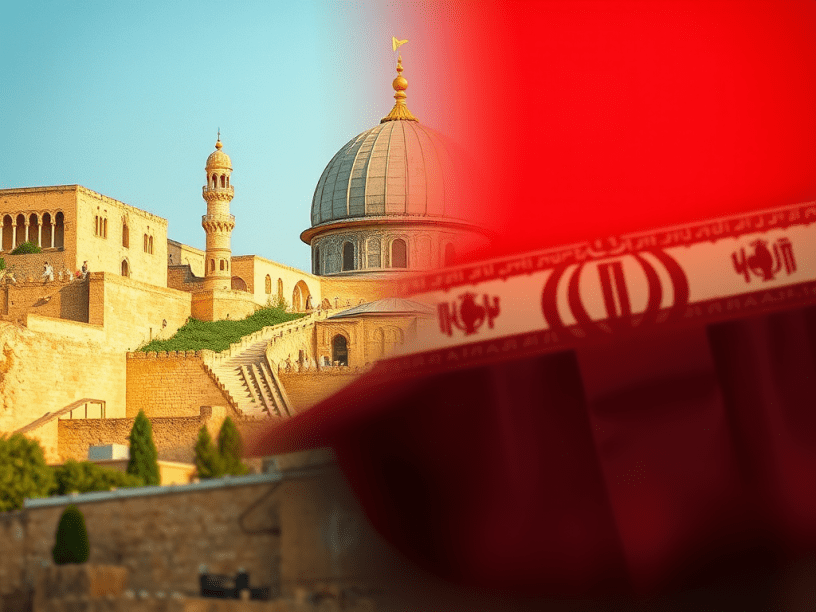
Is This A Religious War?
Many people across the world believe that what we see in the Middle East right now is a war involving three Abrahamic religions, thus making it a ‘religious’ war:’
- Iran – Majority Shiah Muslim nation
- Israel – Majority Jewish nation
- United States – Majority Christian nation
- Arab countries – Majority Sunni Muslim nations
“The conflict has mutated into a zero-sum collision of competing messianic frameworks. The United States–Israeli war on Iran is as much a collision of competing religious ideologies as it is a clash of strategic interests. To understand it purely through a secular realist lens is to miss half the story.
After the March 2 Pentagon press briefing, US Secretary of War Pete Hegseth declared that “crazy regimes like Iran hell-bent on prophetic Islamist delusions cannot have nuclear weapons”. Separately, Secretary of State Marco Rubio described Iran’s rulers as “religious fanatic lunatics.” The US-Israel war on Iran is shaped by religion as much as strategy, Aljazeera
Islam is the youngest of the three Abrahamic religions. Judaism is the oldest. Christianity is in the middle – time wise. Let’s begin with the oldest to get an idea about what’s behind this current conflict from Israel’s perspective.
Jewish
Abraham was called “the Hebrew” in the Old Testament. He fathered many children, but Isaac was viewed as the ‘son of promise’ (Genesis chapters 17, 18, 21, 22). Abraham thought that Ishmael would be his son of promise because he was born first; plus Abraham thought his wife was too old to have children, especially since she had been ‘barren’ (Genesis 11:30).
However, that was not God’s plan:
“And Abraham said to God, “Oh, that Ishmael might live before You!” Then God said: “No, Sarah your wife shall bear you a son, and you shall call his name Isaac; I will establish My covenant with him for an everlasting covenant, and with his descendants after him. And as for Ishmael, I have heard you. Behold, I have blessed him, and will make him fruitful, and will multiply him exceedingly. He shall beget twelve princes, and I will make him a great nation.” Genesis 17:18-20
What was the ‘promise’ to which Abraham referred? Here’s what God promised when He called Abram to leave his home country tor the land of Canaan:
“I will make you a great nation; I will bless you And make your name great; And you shall be a blessing. I will bless those who bless you, And I will curse him who curses you; And in you all the families of the earth shall be blessed.” Genesis 12:2-3
Isaac became the father of two sons: Esau and Jacob. They were twins. Though Esau was born first, he sold his birthright to Jacob for a bowl of stew. That showed how Esau had a low view of his birthright. Later, Jacob tricked his father into giving him Esau’s blessing. Jacob ran away to escape Esau’s anger, but Esau forgave Jacob many years later.
Esau had five sons with three wives. Those sons became leaders of tribes in the land of Seir that eventually became known as the Kingdom of Edom. The Edomites became polytheists (worshipping many gods).
Jacob had twelve sons and one daughter with two wives and their maidservants (four women total). Those sons became the leaders of twelve tribes of Israel (God changed Jacob’s name to Israel in Genesis 32:28).
Jacob and his sons moved from Canaan to Egypt for a better life (read the reason why in Genesis chapters 37-49). However, they eventually became slaves to the Egyptians and cried out to God for relief. God sent Moses to free the Hebrews from slavery and take them to the ‘promised land.’ God also spoke to Israel through Moses to give the people His Law that would guide them in serving Him and only Him once they took possession of the promised land. Read the Book of Judges to see what the Israelites did and how they suffered for their disobedience.
The Jewish Holy Book
The Jewish Holy Book is also known as the ‘Jewish Bible,’ the ‘Hebrew Bible,’ or the ‘Tanakh’ (Tanach – תנ׳ך). The word ‘Tanakh’ is an acronym for the three main sections of the Hebrew Bible: the Torah (Law/Teaching, Five Books of Moses – תורה), the Nevi’im (Prophets – נביאים), and the Ketuvim (Writings – כתובים). Here’s a detailed article if you’d like to learn more about the Jewish Bible: What Is In The Jewish Bible?
The Torah, which God gave to Moses, contains a total of 613 Commandments. 248 of those Commandments are about what to do and 365 are about what not to do. God gave those Commandments to Moses and the children of Israel after He freed them from slavery in Egypt. Those Commandments included how God (YHWH – יהוה – also known as Yahweh, Jehowah, Adonai) directed Israel to worship Him only, cast out false gods and those who worshipped them, build a Tabernacle where they would sacrifice to priests for their sin and where God would dwell with them, how they would treat each other and live together properly, and enter the promised land to take possession of it from the pagan Gentile nations.
God directed King Solomon (son of King David) to build a Temple in Jerusalem to become a permanent replacement for the Tabernacle of Meeting.
“Now Solomon began to build the house of the Lord at Jerusalem on Mount Moriah, where the Lord had appeared to his father David, at the place that David had prepared on the threshing floor of Ornan the Jebusite.” 2 Chronicles 3:1
However, the Babylonians destroyed Solomon’s Temple in the early part of the 6th century BC when they leveled Jerusalem and took Jews captive to Babylon. Jews rebuilt the Temple after Persia’s King Cyrus freed them from Babylonian captivity in the 6th century BC. King Herod extended the Second Temple in the 1st century BC. However, the Romans destroyed the Second Temple in 70 AD when it destroyed Jerusalem and brought the nation of Israel to ruins. The Jews have not had a Temple since 70 AD, but some Jews believe the Messiah (Moshiach) will build a Third Temple on the Temple Mount when he comes into power in the future. Interestingly, two Islamic structures currently sit on the Temple Mount: the Dome of the Rock and the Al-Aqsa Mosque.
One important question is how a Third Jewish Temple will sit on the same Temple Mount where Muslims have multiple structures – some of the most important religious buildings in Islam. Some Jews believe the Temple will descend from Heaven to the Temple Mount. Some believe it may be destroyed in a war and Jews would rebuild the Temple. Others believe Messiah will come in the future and rebuild the Temple. However, many Jews do not believe there will ever be a Third Temple. It’s helpful to remember that almost half of all Jews living in Israel today are ‘secular’ Jews and another 20% are ‘secular-traditional.’ You may find this article in ‘The Times of Israel’ helpful in explaining why. I’ll share a bit more about that in the next section.
The Messiah
The ‘coming’ of Messiah plays a large role for some religious peole in the current war. Many Jews, Christians, and Muslims believe in a ‘Messiah’ who will be a ‘king’ and will rule the world. Here’s the Jewish view of Messiah (mashiach):
“Belief in the eventual coming of the mashiach is a basic and fundamental part of traditional Judaism. It is part of Rambam’s 13 Principles of Faith, the minimum requirements of Jewish belief. In the weekday Shemoneh Esrei prayer, recited three times daily, we pray for all of the elements of the coming of the mashiach: ingathering of the exiles; restoration of the religious courts of justice; an end of wickedness, sin and heresy; reward to the righteous; rebuilding of Jerusalem; restoration of the line of King David; and restoration of Temple service.
Modern scholars suggest that the messianic concept was introduced later in the history of Judaism, during the age of the prophets. They note that the messianic concept is not explicitly mentioned anywhere in the Torah (the first five books of the Bible).
However, traditional Judaism maintains that the messianic idea has always been a part of Judaism. The mashiach is not mentioned explicitly in the Torah, because the Torah was written in terms that all people could understand, and the abstract concept of a distant, spiritual, future reward was beyond the comprehension of some people. However, the Torah contains several references to “the End of Days” (acharit ha-yamim), which is the time of the mashiach; thus, the concept of mashiach was known in the most ancient times.
The term “mashiach” literally means “the anointed one,” and refers to the ancient practice of anointing kings with oil when they took the throne. The mashiach is the one who will be anointed as king in the End of Days.
The mashiach will be a great political leader descended from King David (Jeremiah 23:5). The mashiach is often referred to as “mashiach ben David” (mashiach, son of David). He will be well-versed in Jewish law, and observant of its commandments (Isaiah 11:2-5). He will be a charismatic leader, inspiring others to follow his example. He will be a great military leader, who will win battles for Israel. He will be a great judge, who makes righteous decisions (Jeremiah 33:15). But above all, he will be a human being, not a god, demi-god or other supernatural being.” The Messianic Idea in Judaism, Judaism 101
Daniel the prophet wrote during the Babylonian exile about the coming of Israel’s Messiah:
“Seventy weeks are determined For your people and for your holy city, To finish the transgression, To make an end of sins, To make reconciliation for iniquity, To bring in everlasting righteousness, To seal up vision and prophecy, And to anoint the Most Holy. “Know therefore and understand, That from the going forth of the command To restore and build Jerusalem Until Messiah the Prince, There shall be seven weeks and sixty-two weeks; The street shall be built again, and the wall, Even in troublesome times. “And after the sixty-two weeks Messiah shall be cut off, but not for Himself; And the people of the prince who is to come Shall destroy the city and the sanctuary. The end of it shall be with a flood, And till the end of the war desolations are determined.” Daniel 9:24-26
An important point to note here is Daniel’s breakdown of the ‘seventy weeks.’ The purpose was to ‘finish the transgression, To make an end of sins, To make reconciliation for iniquity, To bring in everlasting righteousness, To seal up vision and prophecy, And to anoint the Most Holy.’ Then Daniel mentions, ‘from the going forth of the command To restore and build Jerusalem Until Messiah the Prince, There shall be seven weeks and sixty-two weeks … And after the sixty-two weeks Messiah shall be cut off, but not for Himself; And the people of the prince who is to come Shall destroy the city and the sanctuary. The end of it shall be with a flood, And till the end of the war desolations are determined.’ These ‘weeks’ are important in understanding what’s happened and what’s coming. We’ll go more in depth on those ‘weeks’ as our series continues.
The prophet Micah identified the birthplace of the Messiah:
“But you, Bethlehem Ephrathah, Though you are little among the thousands of Judah, Yet out of you shall come forth to Me The One to be Ruler in Israel, Whose goings forth are from of old, From everlasting.” Therefore He shall give them up, Until the time that she who is in labor has given birth; Then the remnant of His brethren Shall return to the children of Israel.” Micah 5:1-3
The prophet Zechariah wrote about the coming ‘King’ of Israel even though he prophesied years after Babylon had captured the last Jewish king of the lineage of David. That king died in captivity leaving no heir to carry on the Davidic line. Question? If there is no one who can lay claim to the kingly line of David, how will God complete His covenant with David? We’ll find out soon.
“Rejoice greatly, O daughter of Zion! Shout, O daughter of Jerusalem! Behold, your King is coming to you; He is just and having salvation, Lowly and riding on a donkey, A colt, the foal of a donkey.” Zechariah 9:9
That’s an unusual statement about how a king would come into a position of world domination. How would a ‘king’ come in a ‘lowly’ manner ‘riding on the ‘foal of a donkey?’ That isn’t the normal picture we would have in our minds of a ‘conquering king.’ So, what is the Jewish perspective?
Keep in mind that the majority of today’s Jews view their religion differently than Jews did hundreds or thousands of years ago. The ‘Orthodox’ community of Jews (Haredi, or “strictly” Orthodox) number about one-in-seven of all Jews today. Because of the increased births in that community, the number is expected to rise to one-in -five by 2040. There are also Modern Orthodox Jews, Conservative Jews, Reform Jews, and Secular Jews.
Here’s another view from Pew Research:
“A new Pew Research Center survey finds that nearly all Israeli Jews self-identify with one of four subgroups: Haredi (“ultra-Orthodox”), Dati (“religious”), Masorti (“traditional”) and Hiloni (“secular”). Beyond differences in religious belief and practice, these groups inhabit largely distinct social worlds characterized by their own lifestyles and politics.” Pew Research
And from the Israeli government:
“Basically, the majority may be characterized as secular Jews who manifest modern lifestyles, with varied degrees of respect for and practice of religious precepts. Within this majority are many who follow a modified traditional way of life, with some choosing to affiliate with one of the liberal religious streams.” Ministry of Foreign Affairs
Many Jews believe the Messiah will be a direct descendant of King David, fulfilling God’s promise to David in 2 Samuel 7. They believe Messiah will be a military leader and establish Israel as the most powerful nation in the world. They believe Messiah will end wars and bring in a ‘Messianic era’ that will bring peace to the world through His rule.
“The final Messiah will be the greatest leader and political genius that the world has ever seen. He will likewise be the wisest man ever to have lived. He will put these extraordinary talents to use to precipitate a worldwide revolution which will bring perfect social justice to humanity, and influence all people to serve God with a pure heart.
The Messiah will also achieve prophecy and become the greatest prophet in history, second only to Moses.” All About The Jewish Messiah
According to the Jewish Bible a ‘messenger’ will precede the arrival of the Messiah and announce His coming to Jerusalem:
“Comfort, yes, comfort My people!” Says your God. “Speak comfort to Jerusalem, and cry out to her, That her warfare is ended, That her iniquity is pardoned; For she has received from the Lord’s hand Double for all her sins.” The voice of one crying in the wilderness: “Prepare the way of the Lord; Make straight in the desert A highway for our God. Every valley shall be exalted And every mountain and hill brought low; The crooked places shall be made straight And the rough places smooth; The glory of the Lord shall be revealed, And all flesh shall see it together; For the mouth of the Lord has spoken.” Isaiah 40:1-5
“Behold, I send My messenger, And he will prepare the way before Me. And the Lord, whom you seek, Will suddenly come to His temple, Even the Messenger of the covenant, In whom you delight. Behold, He is coming,” Says the Lord of hosts. “But who can endure the day of His coming? And who can stand when He appears? For He is like a refiner’s fire And like launderers’ soap. He will sit as a refiner and a purifier of silver; He will purify the sons of Levi, And purge them as gold and silver, That they may offer to the Lord An offering in righteousness.” Malachi 3:1-3
Malachi was the last prophet in the Jewish Bible, living at the end of the 5th century BC – almost 2,500 year ago. Jews who believe the words of the prophets say that this was God’s final Word to Israel, so they are waiting for the ‘messenger’ and the Messiah to arrive in Jerusalem to establish God’s Kingdom on Earth.
Next Time
Muslims have a different view of the Messiah, which many people believe plays importantly into the war that Iran has been waging against Israel for many years. I’ll share what they believe in the next part of my series, Iran and Israel at War.
Scripture taken from the New King James Version®. Copyright © 1982 by Thomas Nelson. Used by permission. All rights reserved.
Faith and Self Defense © 2026

 Faith & Self Defense