

Preaching the Gospel has a purpose – to transform lives. The Gospel is not about tickling ears or promoting preachers. It’s about life transformation. That is front and center in the way Jesus proclaimed His Gospel. It should be front and center in our service as well.
The Gospel’s Power
The Apostle Paul wrote that he was “not ashamed of the gospel of Christ, for it is the power of God to salvation for everyone who believes, for the Jew first and also for the Greek” (Romans 1:16). The Gospel of Christ is just what it says – “Christ’s Gospel.” It’s not good news from humans. It’s good news from God.
The beginning of the gospel of Jesus Christ, the Son of God. As it is written in the Prophets: ‘Behold, I send My messenger before Your face, Who will prepare Your way before You.’ ‘The voice of one crying in the wilderness: ‘Prepare the way of the Lord; Make His paths straight.’ Mark 1:1-3
The Gospel of Christ began with the fulfillment of Old Testament prophecies concerning God sending a “messenger” to prepare the “way of the Lord.” John the Baptist was that messenger. How did John prepare the way? By preaching a baptism of repentance for the remission of sins (Mark 1:4). John preached and baptized for the purpose that Jews would confess their sins in preparation for the coming of Israel’s Messiah. How did people respond to John’s preaching?
Then all the land of Judea, and those from Jerusalem, went out to him and were all baptized by him in the Jordan River, confessing their sins. Mark 1:5
John baptized Jesus, even though Jesus had not committed any sins. Jesus’ baptism was not about confession. It was about “commission.” God the Father had sent His Son from Heaven to earth to preach Good News and die and rise from the dead to destroy the works of the devil.
It came to pass in those days that Jesus came from Nazareth of Galilee, and was baptized by John in the Jordan. And immediately, coming up from the water, He saw the heavens parting and the Spirit descending upon Him like a dove. Then a voice came from heaven, ‘You are My beloved Son, in whom I am well pleased. Mark 1:9-11
And John bore witness, saying, ‘I saw the Spirit descending from heaven like a dove, and He remained upon Him. I did not know Him, but He who sent me to baptize with water said to me, ‘Upon whom you see the Spirit descending, and remaining on Him, this is He who baptizes with the Holy Spirit.’ And I have seen and testified that this is the Son of God. John 1:32-34
For this purpose the Son of God was manifested, that He might destroy the works of the devil. 1 John 3:8
The Gospel of Christ has a special power – the power to change people’s lives – now and forever. Here’s how Jesus explained that power:
So He came to Nazareth, where He had been brought up. And as His custom was, He went into the synagogue on the Sabbath day, and stood up to read. And He was handed the book of the prophet Isaiah. And when He had opened the book, He found the place where it was written: ‘The Spirit of the Lord is upon Me, Because He has anointed Me To preach the gospel to the poor; He has sent Me to heal the brokenhearted, To proclaim liberty to the captives And recovery of sight to the blind, To set at liberty those who are oppressed; To proclaim the acceptable year of the Lord.’ Then He closed the book, and gave it back to the attendant and sat down. And the eyes of all who were in the synagogue were fixed on Him. And He began to say to them, ‘Today this Scripture is fulfilled in your hearing.’ Luke 4:16-21
Notice key “transformation” verbs and who would experience transformation:
- preach to the poor
- heal the brokenhearted
- proclaim liberty to the captives
- recovery of sight to the blind
- set at liberty those who are oppressed
- proclaim the acceptable year of the Lord
- this Scripture is fulfilled in your hearing
These were not idle words. By the time Jesus spoke at the synagogue in Nazareth (where He had grown up), He had already become well-known in the region for preaching the Gospel (Luke 4:14-15). Preaching, teaching and healing were at the heart of Jesus proclaiming repentance “for the kingdom of heaven is at hand” (Matthew 4:7).
The Gospel in Galilee
Jesus began His public ministry in Galilee.
Then Jesus returned in the power of the Spirit to Galilee, and news of Him went out through all the surrounding region. Luke 4:14
Here’s why He started in Galilee:
And leaving Nazareth, He came and dwelt in Capernaum, which is by the sea, in the regions of Zebulun and Naphtali, that it might be fulfilled which was spoken by Isaiah the prophet, saying: ‘The land of Zebulun and the land of Naphtali, By the way of the sea, beyond the Jordan, Galilee of the Gentiles: The people who sat in darkness have seen a great light, And upon those who sat in the region and shadow of death Light has dawned. From that time Jesus began to preach and to say, ‘Repent, for the kingdom of heaven is at hand.” Matthew 4:13-17
Matthew quoted from Isaiah 9 and 42:
Nevertheless the gloom will not be upon her who is distressed, As when at first He lightly esteemed The land of Zebulun and the land of Naphtali, And afterward more heavily oppressed her, By the way of the sea, beyond the Jordan, In Galilee of the Gentiles. The people who walked in darkness Have seen a great light; Those who dwelt in the land of the shadow of death, Upon them a light has shined. Isaiah 9:1-2
I, the Lord, have called You in righteousness, And will hold Your hand; I will keep You and give You as a covenant to the people, As a light to the Gentiles, To open blind eyes, To bring out prisoners from the prison, Those who sit in darkness from the prison house. Isaiah 42:6-7
Even though Jesus was born in Bethlehem (near Jerusalem) and spent time there with his parents as an infant, an angel of the Lord appeared to Joseph in a dream and told him to take Jesus and Mary and flee to Egypt – “for Herod will seek the young Child to destroy Him” (Matthew 2:13). When King Herod was dead, an angel of the Lord appeared to Joseph in a dream and told him to return to Israel with Jesus and Mary. Joseph decided to go into the region of Galilee based on another dream. Matthew wrote – “And he came and dwelt in a city called Nazareth, that it might be fulfilled which was spoken by the prophets, ‘He shall be called a Nazarene” (Matthew 2:23).
The Gospel in Nazareth
The term “Nazarene” was used for someone who was despised. We see that in John 1 when Nathanael asked, “Can anything good come out of Nazareth?” (John 1:46) We are reminded by Isaiah that the Messiah would be “despised and rejected by men” (Isaiah 53:3). King David also said that the Messiah would be a “reproach of men, and despised by the people” (Psalm 22:6).
Nazareth was apparently where Mary, the mother of Jesus, grew up:
Now in the sixth month the angel Gabriel was sent by God to a city of Galilee named Nazareth, to a virgin betrothed to a man whose name was Joseph, of the house of David. The virgin’s name was Mary. Luke 1:26-27
Joseph, the step-father of Jesus, was also from Nazareth or lived nearby:
Joseph also went up from Galilee, out of the city of Nazareth, into Judea, to the city of David, which is called Bethlehem, because he was of the house and lineage of David, to be registered with Mary, his betrothed wife, who was with child. Luke 2:4-5
We know that Jesus grew up in Nazareth. He lived there as a young child and was still there at the age of twelve:
And when He was twelve years old, they went up to Jerusalem according to the custom of the feast … Then He went down with them and came to Nazareth, and was subject to them, but His mother kept all these things in her heart. And Jesus increased in wisdom and stature, and in favor with God and men. Luke 2:42, 51-52
As far as we know, Jesus continued to live in Nazareth until the people of the small village tried to kill Him. I say small because Nazareth was estimated to have only 400 people in the early part of the 1st century AD. Jesus and his family would have been well known in the village as we see from the villagers’ reaction to His teaching in the synagogue:
And they said, ‘Is this not Joseph’s son?’ Luke 4:22
And many hearing Him were astonished, saying, ‘Where did this Man get these things? And what wisdom is this which is given to Him, that such mighty works are performed by His hands! Is this not the carpenter, the Son of Mary, and brother of James, Joses, Judas, and Simon? And are not His sisters here with us?’ So they were offended at Him. Mark 6:2-3
They knew Jesus as being the son of Joseph and Mary, having brothers and sisters, and being a carpenter by trade. They were not able to accept Him as the Messiah or even a prophet.
But Jesus said to them, ‘A prophet is not without honor except in his own country, among his own relatives, and in his own house.’ Now He could do no mighty work there, except that He laid His hands on a few sick people and healed them. And He marveled because of their unbelief. Then He went about the villages in a circuit, teaching. Mark 6:4-6
That is amazing when you think about it. Jesus spent most of His life in Nazareth. We know from Luke 2:51-52 that Jesus was subject (obedient) to His earthly parents and “increased in wisdom and stature, and in favor with God and men.” That meant the people of Nazareth would have known Jesus to be a wise and obedient son, someone who would have their favor. Yet, when faced with the proposition that this Jesus they knew was also the Messiah God had promised to Israel was beyond their comprehension. No wonder Jesus said that a prophet is not without honor except in his own country, among his own relatives, and in his own house. The people of Nazareth rejected Jesus as Messiah.
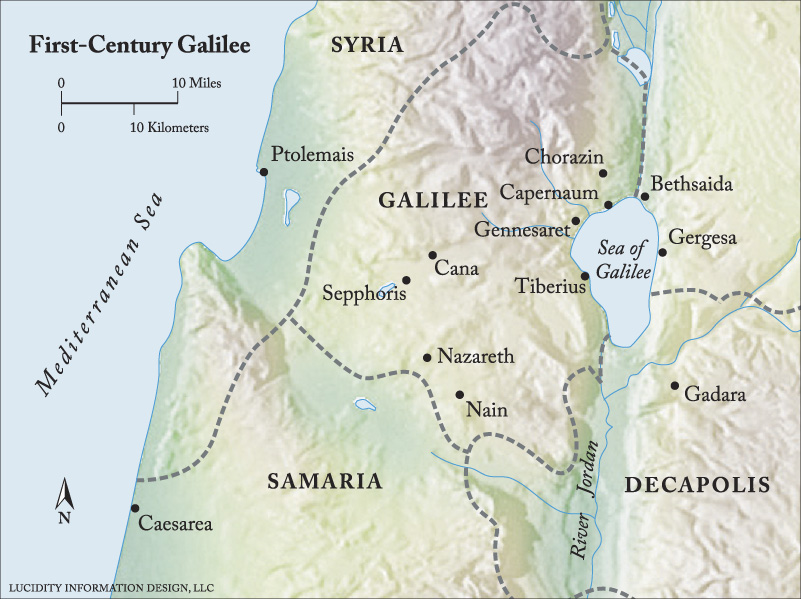
Nazareth was located in the southern (lower) part of Galilee. Galilee was located in the northern (upper) part of Israel. Syria was to its north and west. Decapolis was located to its southeast. Samaria was to its south, along with Judea which was located south of Samaria. Galilee was a route for Gentiles entering and leaving Israel during Jesus’ lifetime.
Nazareth was located about 65 miles north of Jerusalem and about 20 miles southwest from Capernaum.
The Gospel in Capernaum
After the people of Nazareth attempted unsuccessfully to throw Jesus over a cliff, He went to Capernaum. We learn a lot about Jesus’ early ministry by what He did in Capernaum. One of the first things we notice is His authority in both word and deed:
Then He went down to Capernaum, a city of Galilee, and was teaching them on the Sabbaths. And they were astonished at His teaching, for His word was with authority. Now in the synagogue there was a man who had a spirit of an unclean demon. And he cried out with a loud voice, saying, ‘Let usalone! What have we to do with You, Jesus of Nazareth? Did You come to destroy us? I know who You are—the Holy One of God!’ But Jesus rebuked him, saying, ‘Be quiet, and come out of him!’ And when the demon had thrown him in their midst, it came out of him and did not hurt him. Then they were all amazed and spoke among themselves, saying, ‘What a word this is! For with authority and power He commands the unclean spirits, and they come out.’ And the report about Him went out into every place in the surrounding region. Luke 4:31-37
The people of Capernaum had never seen anyone with that kind of authority. Jesus healed people who were sick with various diseases. “He laid His hands on every one of them and healed them” (Luke 4:40). Jesus also cast demons out of many people. The demons knew that Jesus was “the Christ, the Son of God,” but He would not allow them to speak. The people of Capernaum wanted Jesus to stay in their city and continue to teach and heal, but He said “I must preach the kingdom of God to the other cities also, because for this purpose I have been sent” (Luke 4:43). Jesus left Capernaum and preached in other synagogues of Galilee. He would return to Capernaum many times during His earthly ministry.
Capernaum was a town of about 15-hundred people located on the northwest shore of the Sea of Galilee. Also known as Lake of Gennesaret (Luke 5:1) and Sea of Tiberius (John 6:1), the Sea of Galilee was a large body of water (13 miles long and mile wide – an estimated 41-thousand acre lake) where many people made their living by fishing.
Jesus transformed the lives of four fishermen by calling them to become His disciples:
And as He walked by the Sea of Galilee, He saw Simon and Andrew his brother casting a net into the sea; for they were fishermen. Then Jesus said to them, ‘Follow Me, and I will make you become fishers of men.’ They immediately left their nets and followed Him. When He had gone a little farther from there, He saw James the son of Zebedee, and John his brother, who also were in the boat mending their nets. And immediately He called them, and they left their father Zebedee in the boat with the hired servants, and went after Him. Mark 1:16-20
[Podcast version of this study coming soon.]
eBook
You can download a free eBook of Chapters One – Five of this study here. Please share with family and friends as God leads.
Next Time
The disciples learned firsthand in Galilee how Jesus can transform lives. They watched as He preached, taught, healed, raised the dead and cast out demons. We’ll learn more about the Gospel Jesus preached in Galilee and how He transformed lives in the next part of our special series, Evangelistic Apologetics – A Closer Look.
Scripture taken from the New King James Version®. Copyright © 1982 by Thomas Nelson. Used by permission. All rights reserved.
Faith and Self Defense © 2025

 Faith & Self Defense