
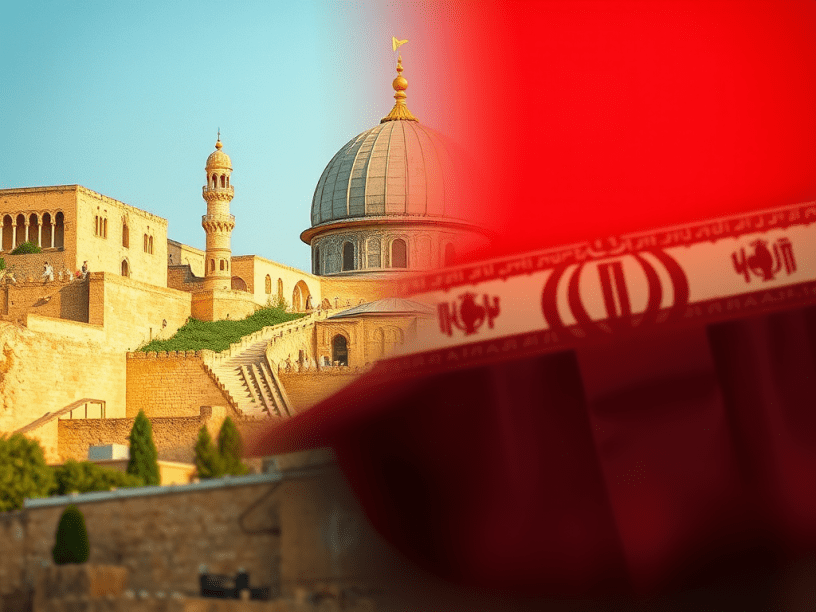
This series is about the current war between Iran and Israel (plus the involvement of the United States). As I mentioned in the first part of this series, the first war in the Bible (Genesis 14) included the King of Elam (ancient Iran) and Abraham (grandfather to Jacob/Israel). That was about four thousand years ago and there have been many wars since then.
In the last part of this series I delved briefly into God’s prophecies concerning Elam and Persia (later known as Iran). Many Christians ask what did God mean when He told Isaiah and Jeremiah to prophesy about ancient Iran. Does the current war have anything prophetic significance that we should understand?
There’s nothing wrong with that question. However, the way we get to the correct answer is vitally important. Many Christians believe what someone else believes about a portion of Scripture or a particular teaching in the Bible. They have their favorite authors, pastors, conference speakers, and TV preachers. However, I don’t recommend you buy into what they write or say unless you’re sure they know how to ‘rightly divide’ God’s Word. What do I mean by that?
A Little Background About Interpreting Scripture
The Apostle Paul told his disciple and fellow worker Timothy this almost two thousand years ago:
“Be diligent to present yourself approved to God, a worker who does not need to be ashamed, rightly dividing the word of truth.” 2 Timothy 2:15
Paul wrote those words in the context of Timothy’s spiritual upbringing, his not being ashamed of the Gospel, his being loyal to the Christian faith, being strong in God’s grace, and enduring hardships. It was after those words that Paul told Timothy to do three things:
- Be diligent to present yourself approved to God
- a worker who does not need to be ashamed
- rightly dividing the word of truth
‘Right division’ is not a quick approach to discovering truth in the Bible, but it’s necessary to be sure we’re discovering the truth. The Greek word translated ‘rightly dividing’ is ὀρθοτομέω. It means ‘to make a straight cut, to dissect correctly.’ I don’t think it’s necessary for every Christian to know the original languages of the Bible, but I would recommend that you make sure the Bible teachers you trust do know. Remember, God views Bible teachers as ‘workers’ who should not ‘be ashamed.’ Why? Because they should be diligent to present themselves ‘approved to God.’ God’s approval as a Bible teacher is KEY. A Bible teacher does not exist to please anyone other than God. In the process of pleasing God, a Bible teacher will please some people and displease some people. That’s the nature of representing God and presenting His Word without shame.
Even if a Bible teacher mentions a Hebrew, Aramaic, or Greek word in their teaching, that doesn’t mean they’re using the word correctly. The more you know the Bible, the better you can identify teachers who are ‘rightly dividing’ God’s Word. How do you do that? Read the Bible again, again, and again. Keep reading it. If you are not sure about the original meaning of a word in a Bible translation written in your language, find someone who knows the original, is a ‘right divider’, and take notes.
I came up with a couple of ways of remembering what it means to ‘rightly divide’ God’s Word.
Here’s the first way, in this order:
- Observe everything
- Ask everything
- Answer everything
- Interpret everything
Here’s the second way, in this order:
- Text
- Within context
- From the original language
- To the original reader
Those simple ideas have helped me greatly through the years as I’ve studied and taught the Bible. I want to be sure that I know the correct definition of every word I’m studying from the original language. I also want to know who wrote it, to whom they wrote it, why they wrote it, the full context of the usage of the word(s) they used, and how it would have been understood in the time period it was written.
James wrote:
“My brethren, let not many of you become teachers, knowing that we shall receive a stricter judgment.” James 3:1
Interpretations
Unfortunately, you can find scores of different interpretations for the same verses and/or subjects in the Bible, depending on who you read, listen to, or watch. Is that what God intended? Does He want everyone to come up with their own interpretation, their ‘own truth’ from His Word? Short answer – NO! Here’s why I say that:
“The secret things belong to the Lord our God, but those things which are revealed belong to us and to our children forever, that we may do all the words of this law.” Deuteronomy 29:29
There are many things that are secrets to God. He very well may reveal those ‘secret’ things to us when we get to Heaven. However, there are some things that God keeps secret for thousands of years until He is ready to reveal them. Here’s an example:
“For this reason I, Paul, the prisoner of Christ Jesus for you Gentiles— if indeed you have heard of the dispensation of the grace of God which was given to me for you, how that by revelation He made known to me the mystery (as I have briefly written already, by which, when you read, you may understand my knowledge in the mystery of Christ), which in other ages was not made known to the sons of men, as it has now been revealed by the Spirit to His holy apostles and prophets: that the Gentiles should be fellow heirs, of the same body, and partakers of His promise in Christ through the gospel, of which I became a minister according to the gift of the grace of God given to me by the effective working of His power. To me, who am less than the least of all the saints, this grace was given, that I should preach among the Gentiles the unsearchable riches of Christ, and to make all see what is the fellowship of the mystery, which from the beginning of the ages has been hidden in God who created all things through Jesus Christ; to the intent that now the manifold wisdom of God might be made known by the church to the principalities and powers in the heavenly places, according to the eternal purpose which He accomplished in Christ Jesus our Lord, in whom we have boldness and access with confidence through faith in Him.” Ephesians 3:1-12
Notice that God revealed a ‘mystery’ to the Apostle Paul that He had not made known to men ‘in other ages.’ Why? Because God planned it that way. The word ‘mystery’ in Greek is μυστήριον. It means ‘a secret.’ God knew from before the beginning of time that Gentiles would become ‘fellow heirs, of the same body, and partakers of His promise in Christ through the gospel.’ However, God kept that a ‘secret’ until He revealed it through Paul. Because God called Israel His ‘chosen people,’ Jews through the centuries have had negative view of Gentiles. Jesus Christ called Paul (Saul of Tarsus) and gave him a special mission of taking the Gospel to the Gentiles and their rulers (Acts 9). Paul even identified himself as ‘an apostle to the Gentiles’ (e.g. Romans 11:13; 2 Timothy 1:11), and the Jewish apostles agreed that they would go to the circumcised (Jews) while Paul took the Gospel to the uncircumcised (e.g. Acts 15; Galatians 2).
Paul went even further and revealed under the inspiration of the Holy Spirit:
“Therefore remember that you, once Gentiles in the flesh—who are called Uncircumcision by what is called the Circumcision made in the flesh by hands— that at that time you were without Christ, being aliens from the commonwealth of Israel and strangers from the covenants of promise, having no hope and without God in the world. But now in Christ Jesus you who once were far off have been brought near by the blood of Christ. For He Himself is our peace, who has made both one, and has broken down the middle wall of separation, having abolished in His flesh the enmity, that is, the law of commandments contained in ordinances, so as to create in Himself one new man from the two, thus making peace, and that He might reconcile them both to God in one body through the cross, thereby putting to death the enmity. And He came and preached peace to you who were afar off and to those who were near. For through Him we both have access by one Spirit to the Father.” Ephesians 2:11-18
This was a surprise to the Jewish apostles as you can read in the early chapters of the Book of Acts. Why was Peter surprised by what God asked him to do in taking the Gospel to the home of a Gentile in Acts 10? Because God was keeping that a secret (mystery) until the time He determined to reveal it to Peter and the other apostles. It was always God’s plan from eternity to do what we read in Paul’s letters, but God kept it secret for centuries until He was ready to “create in Himself one new man from the two, thus making peace, and that He might reconcile them both to God in one body through the cross, thereby putting to death the enmity.” God’s choice. Not mine. Not yours. God’s. That’s what we need to look for in studying the Bible. Not what I believe or some other Bible teacher believes, but what God reveals.
I remember how powerful that was when I first got an understanding from the Greek New Testament as a young Bible teacher. It helped me understand God’s plan for the ages and how to check whether other Bible teachers understood it. I discovered that many did not. How can we reveal God’s plan for the ages if we don’t understand His plan for the ages? Seems like a simple question, yet so many Christians are trusting teachers who don’t know God’s plan to teach them God’s plan. Does that sound logical to you? It doesn’t to me.
Back to the War
Alright, let’s get back to the war between Iran and Israel. They’ve been fighting for years. Nothing new there. Iran has used ‘proxies’ to attack Israel going back to the 1980s:
“Israel, a major U.S. ally, faces regular attacks from Tehran-backed groups—namely Hamas, Hezbollah, and Palestinian Islamic Jihad—who share Iran’s animosity toward Israel and oppose the Jewish state’s existence. Support from Tehran has also enabled Yemen’s rebel Houthi movement to fire missiles toward Israel and attack commercial ships with alleged Israeli ties in the Red Sea, actions the Houthis called a show of solidarity with Hamas amid its latest war with Israel. And during Iran’s first-ever attack on Israeli soil, in April 2024, its partners in Iraq, Lebanon, and Yemen fired drones and rockets at Israel to accompany Tehran’s air strikes.” Council on Foreign Relations
Several U.S. Presidential administrations have seen the danger of Iran as a state sponsor of terrorism that endangered Israel, the United States and its allies:
“The Reagan administration first designated Iran a State Sponsor of Terrorism in 1984, but the Clinton administration was the first to sanction Iran’s proxies. In 1995, the United States sanctioned Hezbollah, a Shiite militia and political movement in Lebanon, Hamas, a Sunni militia and political movement in the Palestinian territories, and Palestinian Islamic Jihad, also a Sunni militia in the Palestinian territories.
Between 1995 and 2022, five administrations – Clinton, Bush, Obama, Trump and Biden – sanctioned 11 Iranian proxy groups in five countries. They also sanctioned 89 leaders* from 13 groups supported by Tehran.
Biden administration (2021 – ): removed designation from one group (Ansar Allah) and sanctioned three leaders.
Clinton administration (1993 – 2001): three groups (Hezbollah, Hamas, Palestinian Islamic Jihad) and six leaders
George W. Bush administration (2001 – 2009): three groups (Hezbollah, Hamas, Palestinian Islamic Jihad) and 14 leaders
Obama administration (2009 – 2017): one group (Kataib Hezbollah) and 34 leaders
Trump administration (2017 – 2021): six groups (Ansar Allah, Asaib Ahl al Haq, Harakat Hezbollah al Nujaba, Zaynabiyoun Brigade, Fatemiyoun Division, Al Ashtar Brigades, Saraya al Mukhtar) and 32 leaders.” The Woodrow Wilson International Center for Scholars
It’s important to remember that Israel was not a nation for many centuries. Rome destroyed Israel in 70 AD and Israel did not become a recognized country again until 1948:
“On May 14, 1948, David Ben-Gurion, the head of the Jewish Agency, proclaimed the establishment of the State of Israel. U.S. President Harry S. Truman recognized the new nation on the same day.” Office of the United States Historian
The reason I mention that is because Iran (i.e. Persia) could not have been at war with Israel from 70 AD to 1948 AD (almost 1,900 years) because Israel did not exist as a nation. We have to go back much further in time to find a mention of Israel and Iran (i.e. Persia, Elam) being involved in any type of conflict with Israel.
Isaiah’s Prophecy
In fact, we have to go back thousands of years to the time of the Old Testament prophets. We addressed Isaiah and Jeremiah’s prophecies in a previous part of this series. Since Isaiah preceded Jeremiah by almost a century, let’s begin with Isaiah.
“The burden against the Wilderness of the Sea. As whirlwinds in the South pass through So it comes from the desert, from a terrible land. A distressing vision is declared to me; The treacherous dealer deals treacherously, And the plunderer plunders. Go up, O Elam! Besiege, O Media! All its sighing I have made to cease.” Isaiah 21:1-2
Iran was not always the massive land mass that it is now (636,400 square miles), making it the the 17th largest country in the world. Ancient Elam was much smaller, though it was a well-known power in the 3rd, 2nd, and part of the 1st millennium. Elam began to lose its position of power among the nations when Assyria attacked the capitol city of Susa in the middle of the 7th century BC. Elam was finally fully absorbed into the Persian Empire about a hundred years after that.
Another country mentioned in Isaiah’s prophecy is ‘Media.’ Who or what was that?
“Media, ancient country of northwestern Iran, generally corresponding to the modern regions of Azerbaijan, Kurdistan, and parts of Kermanshah. Media first appears in the texts of the Assyrian king Shalmaneser III (858–824 bc), in which peoples of the land of “Mada” are recorded. The inhabitants came to be known as Medes.” Britannica
You can read about the Medes and Persians in the Books of Daniel and Esther. The Medes are mentioned in 2 Kings chapters 17 and 18 as well as Isaiah, Jeremiah, Daniel, and Esther. The Medes played a key role in defeating Assyria in the late 7th century BC. However, King Cyrus of Persia defeated King Astyages of Media in 550 BC which led to the usage of the name ‘Medes and Persians:’
“If it pleases the king, let a royal decree go out from him, and let it be recorded in the laws of the Persians and the Medes, so that it will not be altered, that Vashti shall come no more before King Ahasuerus; and let the king give her royal position to another who is better than she.” Esther 1:19
“PERES: Your kingdom has been divided, and given to the Medes and Persians.” Daniel 5:28
The combining of the land and people of Media and Persia made it a powerful nation in the region for two centuries, that is until Alexander the Great defeated King Darius III in the latter part of the 4th century BC ending Persian rule for a time. What happened to Persia following its defeat by Alexander’s army? Alexander died early in his life and four of his generals seized the land that Alexander’s army had taken by force. Seleucus II seized control of the eastern lands that included Persia and Mesopotamia at the end of the 4th century BC. However, that didn’t last long. The Seleucids tried to change the people culturally. That eventually led to a revolt from a powerful nomadic tribe known as the Parnis in the middle of the 3rd century BC. They became known as the ‘Parthians’ and ruled Persia for almost 500 years. Internal strife, civil war, continued wars with Rome, and the rise of the Sasanians finally brought the Parthian Empire to an end in the latter part of the 3rd century AD. Persia then became known as the Sasanian Empire.
I could go on, but I think you get the point. Wars and internal strife have changed the rule of countries for thousands of years. One empire ends and another begins. That empire ends and another begins. Rinse and repeat. That’s the history of the world.
God knows the end from the beginning and has declared it through His prophets:
“Remember the former things of old, For I am God, and there is no other; I am God, and there is none like Me, Declaring the end from the beginning, And from ancient times things that are not yet done, Saying, ‘My counsel shall stand, And I will do all My pleasure,’ Calling a bird of prey from the east, The man who executes My counsel, from a far country. Indeed I have spoken it;
I will also bring it to pass. I have purposed it; I will also do it.” Isaiah 46:9-11
One other area to investigate from Isaiah’s prophecy about Elam are the phrases, ‘Wilderness of the Sea,’ ‘As whirlwinds in the South pass through,’ ‘from the desert, from a terrible land.’ Where was that? We get clues from a wider perspective when we look at the broad context that began in Isaiah 13: “The burden against Babylon which Isaiah the son of Amoz saw.” Isaiah 14:3-4 read, “It shall come to pass in the day the Lord gives you rest from your sorrow, and from your fear and the hard bondage in which you were made to serve, that you will take up this proverb against the king of Babylon.” Verses 22-23 read, “For I will rise up against them,” says the Lord of hosts, “And cut off from Babylon the name and remnant, And offspring and posterity,” says the Lord. “I will also make it a possession for the porcupine, And marshes of muddy water; I will sweep it with the broom of destruction,” says the Lord of hosts.”
Where is Babylon today? It no longer exists – just like God said.
“But the glory days of Babylon were short-lived. As foretold by Old Testament prophets, the grand ancient city fell to the Persians in 539 B.C.E. and slowly crumbled over centuries of foreign invasions and occupations.
Although Babylon was designated a UNESCO World Heritage Site in 2019, there isn’t much left to see of the once-unstoppable empire that dazzled Greek historians and enslaved its rivals, most famously the biblical Kingdom of Judah. If you took a trip to Babylon today, located 55 miles (85 kilometers) south of Baghdad, you’d see a tacky recreation built by Saddam Hussein in the 1970s that’s been partially destroyed by decades of war. It’s a sad ending to such a fabled city.” Where Was Babylon and Does It Still Exist?
When we read a more narrow context in Isaiah 21 we come to verse 9: “And look, here comes a chariot of men with a pair of horsemen!” Then he answered and said, “Babylon is fallen, is fallen! And all the carved images of her gods He has broken to the ground.” As we continue to read Isaiah’s prophecy we continue to see that Babylon’s destruction is paramount in the Mind of God and the mouth of the prophet. The last time Isaiah mentions Babylon is in chapter 48:20:
“Go forth from Babylon! Flee from the Chaldeans! With a voice of singing, Declare, proclaim this, Utter it to the end of the earth; Say, “The Lord has redeemed His servant Jacob!”
Isaiah wrote those words in the 7th century BC. Persia destroyed the Babylonian Empire and made it part of Persia in the middle of the 6th century BC. That’s what I would call a ‘near’ prophecy. What God says He will do, He will do. God used the Persians to defeat the nation that had destroyed Jerusalem and the Temple. God often does that. In fact, He has done that for thousands of years. So, is there any prophecy about Elam (i.e. Persia, Iran) that we could call ‘far?’
Jeremiah’s Prophecy
Jeremiah’s prophecy is a little different than Isaiah’s. Jeremiah prophesied in the beginning of the reign of Zedekiah, Judah’s last king before the Babylonians conquered the Jews at the end of the 7th century and early part of the 6th century BC.
“Thus says the Lord of hosts: ‘Behold, I will break the bow of Elam, The foremost of their might. Against Elam I will bring the four winds From the four quarters of heaven, And scatter them toward all those winds; There shall be no nations where the outcasts of Elam will not go. For I will cause Elam to be dismayed before their enemies. And before those who seek their life. I will bring disaster upon them, My fierce anger,’ says the Lord; ‘And I will send the sword after them Until I have consumed them. I will set My throne in Elam, And will destroy from there the king and the princes,’ says the Lord. ‘But it shall come to pass in the latter days: I will bring back the captives of Elam,’ says the Lord.” Jeremiah 49:34-39
This raises a very interesting question about Elam. Was the prophecy about God using the Macedonians to defeat Elam (Persia) or some other empire that would come along later? What did God mean when He told Jeremiah, “I will set My throne in Elam, And will destroy from there the king and the princes,’ says the Lord. ‘But it shall come to pass in the latter days: I will bring back the captives of Elam,’ says the Lord.” When did God set up His throne in Elam (Persia, Iran) and destroy from there the king and the princes? What did God mean by the ‘latter days’ when He would ‘bring back the captives of Elam?’
As you study the history of the many empires that made up Elam/Persia/Iran, you will find many rulers – but you won’t find where God (יְהוָֹה – Yhwh) set up His throne there. The Hebrew word for ‘throne’ is כִּסֵּא. It comes from a root word that means ‘appointed time.’ God would set up His throne in Elam at an appointed time. Has that time passed? Is it a future time? Good question.
God said He would ‘break the bow of Elam.’ The word ‘break’ is שָׁבַר and means ‘shatter, break in pieces, to burst.’ The word ‘bow’ is קֶשֶׁת and is the idea of ‘bending a bow for shooting.’ The word ‘might’ is גְּבוּרָה and means ‘power, strength.’ God said He would shatter Elam as a powerful nation. Has that happened yet? Even though there have been many Iranian empires through the centuries, they have remained a powerful nation.
God then said He would ‘bring the four winds From the four quarters of heaven, And scatter them toward all those winds; There shall be no nations where the outcasts of Elam will not go. For I will cause Elam to be dismayed before their enemies.’ Has this happened yet? Elam (Persia, Iran) has stood strong for centuries against their enemies. The word ‘scatter’ is זָרָה and means ‘dispersed, winnowed, tossed about.’ Is this a past or future event? Has Elam/Persia/Iran been attacked from the four quarters of heaven and scattered toward all those winds?
Keep in mind that God said He would do this when He sets up His throne in Elam. I ask again. When has God set up His throne in Elam, Persia, or Iran? God said he would bring ‘disaster’ upon the country, ‘My fierce anger,’ says the Lord.’ God said He would ‘consume’ them. He repeated that he would set up His ‘throne in Elam’ and destroy from His throne the kings and princes. However, God said that in the ‘latter days’ He would bring back the captives of Elam. ‘Latter days’ is אַחֲרִית and means ‘the last, the end, the future, posterity.’ It comes from a root word that means ‘the hind part, after.’ After what? In context, after God sets up His throne in Elam. The word for ‘sets up’ is שׂוּם and means ‘to put, to appoint.’ God appointed a time when He would set up His throne in Elam and would destroy all of the rulers of that land. However, He would one day ‘bring back the captives of Elam.’ Has that happened or is it a future event.
Context
Context is important when reading or studying any writing, but it’s especially important when studying Scripture. Why? Because it’s God’s Word. Here are a couple of definitions of the word ‘context:’
“the text or speech that comes immediately before and after a particular phrase or piece of text and helps to explain its meaning” Cambridge Dictionary
“the parts of a discourse that surround a word, phrase, or passage and that help to explain its meaning” Merriam-Webster Dictionary
The context of Scripture can be ‘narrow’ or ‘broad.’ What I mean by that is you can look at the narrow context of a portion of Scripture by reading several verses preceding the Scripture portion and several verses following the Scripture portion. You can also look at the broad context by reading several chapters before and following. The fact that I quoted from Jeremiah chapter 49 tells you that it would be good to look at it from both a narrow and broad context. I always encourage Christians to read a Book of the Bible from beginning to end – verse by verse, chapter by chapter. That type of reading will help you understand the ‘context’ of the Book.
For the purpose of this series I want to go back to Jeremiah chapter 46:
“The word of the Lord which came to Jeremiah the prophet against the nations.” verse 1
What follows that statement are the details of God’s words ‘against’ the nations. The following is a list of the nations mentioned in Jeremiah chapters 46-49:
- Egypt
- Philistia/Gaza
- Moab
- Ammon
- Edom
- Damascus, Syria
- Kedar
- Hazor
- Elam
Jeremiah chapter 50, which follows God’s prophecy concerning Elam (Persia, Iran) –
“The word that the Lord spoke against Babylon and against the land of the Chaldeans by Jeremiah the prophet.” verse 1
Interestingly, God promised to destroy the very nation He would use to fight against other nations. That promise continued into Jeremiah chapter 51 –
“So Jeremiah wrote in a book all the evil that would come upon Babylon, all these words that are written against Babylon.” verse 60
This is the broader context of Jeremiah’s prophecy against Elam. As you study the Bible and world history you will find that some of these prophecies were fulfilled close to the time of Jeremiah’s pronouncements, but some (like Elam) may have been far in the future.
One final note for this part of the series. God did mention Israel in His prophecy concerning judging the nations. Here’s what He told Jeremiah to say:
“But do not fear, O My servant Jacob, And do not be dismayed, O Israel! For behold, I will save you from afar, And your offspring from the land of their captivity; Jacob shall return, have rest and be at ease; No one shall make him afraid. Do not fear, O Jacob My servant,” says the Lord, “For I am with you; For I will make a complete end of all the nations To which I have driven you, But I will not make a complete end of you. I will rightly correct you, For I will not leave you wholly unpunished.” Jeremiah 46:27-28
God was going to use other nations to ‘correct’ Israel, but not ‘make a complete end’ of them. God will make a ‘complete end of all the nations’ to which He would ‘drive’ Israel, ‘For I will not leave you wholly unpunished.” God uses nations to ‘correct’ His people, but He says that Israel is His chosen nation.
Next Time
Jews, Christians, and Muslims have disagreed about this prophecy for centuries. I’ll dig into those views in the next parts of my series, Iran and Israel at War.
Scripture taken from the New King James Version®. Copyright © 1982 by Thomas Nelson. Used by permission. All rights reserved.
Faith and Self Defense © 2026

 Faith & Self Defense