
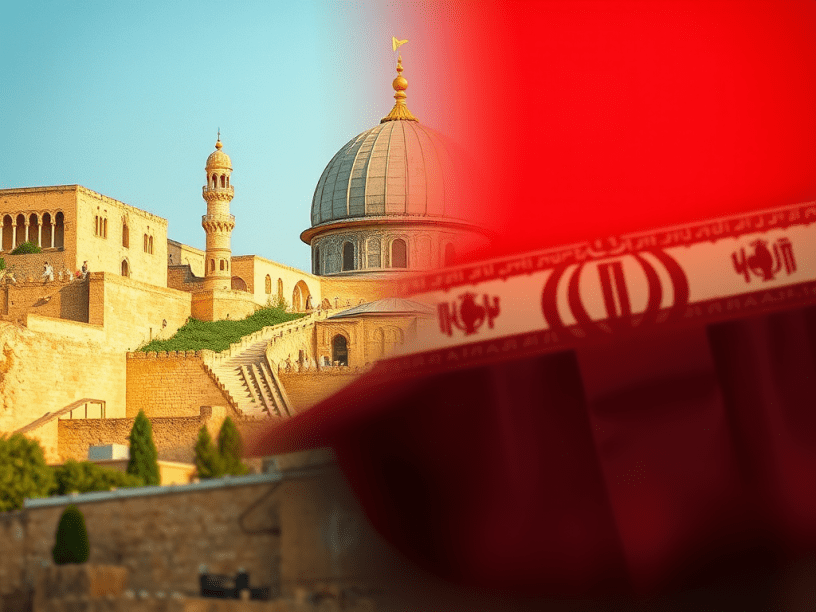
Many people see the current war between Iran and Israel involving three Abrahamic religions: Judaism, Islam, and Christianity. Some view this as just another war among countries with different national objectives; some view it as a ‘religious war.’
I focused on the oldest of the three Abrahamic religions in the last part of the series (Judaism), so I’d like to turn next to the youngest of the three: Islam.
Islam
Iran is now known as the ‘Islamic Republic of Iran’ ((Persian: جمهوری اسلامی ایران, Jomhuri-ye Eslâmi-ye Irân). Here’s a brief history from the UK Islamic Mission:
“Islam is believed to have started when the Angel Jibreel visited the Prophet Muhammad (PBUH) on Mount Hira in 610 A.D. This is seen as the beginning of Islam, as it marks the first of many revelations that would later become the Qur’an. Prophet Muhammad (PBUH) was born in 570 A.D. in Mecca, a city that played a major role in trade. At that time, people in Mecca believed in many gods. However, Muhammad (PBUH) often felt unsure about these beliefs and spent time reflecting alone. During one of these moments, in the year 610 A.D., the Angel Jibreel visited Muhammad (PBUH) while he was in a cave on Mount Hira. This night, known as Laylat al-Qadr (The Night of Power), was when the first verses of the Qur’an were revealed to him. At first, the Prophet Muhammad (PBUH) was unsure of what had happened, but he soon realised that these words were from Allah (SWT). This marked the beginning of Islam, with Muhammad (PBUH) as its final prophet. As Muhammad (PBUH) began to share the message of Islam, some people in Mecca resisted the new teachings. In 622 A.D., he and his followers migrated to the city of Medina, where they were able to practice Islam freely. This event, known as the Hegira, was a major moment in the spread of Islam. Six years after leaving Mecca, Muhammad (PBUH) returned peacefully, and many people in the city began to accept Islam. After the Prophet Muhammad (PBUH) passed away in 632 A.D., Islam continued to grow. His teachings, including the Five Pillars of Islam, became a guide for Muslims all over the world.”
The succession of leadership after Muhammad’s death led to a division within Islam in the 7th century AD. Sunni Muslims believed the succession should be based on an election that began with Abu Bakr, a close advisor and companion of Muhammad. Shia Muslims believed the succession belonged to members of Muhammad’s family, beginning with his cousin/son-in-law, Ali. About 85% of all Muslims are Sunnis today. The other 15% are Shia.
Islam spread quickly through a combination of military conquests, political alliances, and missionary work (da’wah). Islam is now the second largest religion in the world with about two billion members, and is growing rapidly:
“The number of Muslims around the world grew 21% between 2010 and 2020, from 1.7 billion to 2.0 billion. Muslims grew twice as fast as the rest of the world’s population, which expanded by 10% during the same decade. As a result, Muslims grew as a share of the global population, from 24% to 26%.
The number (or count) of Muslims grew in all geographic regions between 2010 and 2020, but the extent of the increase varied widely.
The rate of Muslim growth was the highest in North America, where Muslims numbered 5.9 million in 2020 (up 52%), followed by sub-Saharan Africa, where Muslims grew to 369 million (up 34%).
In every region, Muslims grew at a faster rate than the non-Muslim population, with one exception. In the Latin America-Caribbean region, which has the smallest Muslim population, the number of Muslims increased by 6%, while the region’s non-Muslim population grew by 10%.
As a result, the percentage of Muslims rose in all regions outside of Latin America and the Caribbean. The Muslim share of the population increased the most in the Asia-Pacific region, where Muslims rose to 26% of the population in 2020 (up 1.4 percentage points). Meanwhile, Muslims grew to make up 33% of all residents in sub-Saharan Africa (up 0.8 points) and 6% of Europe’s population (up 0.7 points).” Pew Research
As I mentioned earlier Sunnis are the majority in most Muslim countries. However, Shias are the majority in the Islamic Republic of Iran. Shias believe the ‘Imam’ is a descendant of Muhammad’s family and infallible in areas of religious and political life. The Ayatollah is also specific to ‘Twelver Shia Islam.’
One of the reasons many believe the current war is ‘religious’ in nature is that during the Islamic Revolution in 1979 the Ayatollah Ruhollah Khomeini referred to Israel as the ‘Little Satan” and the United States the ‘Great Satan.’
“Khomeini began to use the phrase soon after the Iranian Revolution (1977-1979), and the metaphor became particularly paramount in the course of the Iran hostage crisis (1979-1981) and remained a cornerstone of the ruling ideology throughout the last three-and-a-half decades. A recent reiteration of this phrase by Khamenei in Persian is the best occasion to think through the phrase and ask what it could possibly mean.” Aljazeera
This article, titled ‘Iran: U.S. and Israeli Threats & Options,’ was written in January of 2023:
“For decades, Iran has considered the United States and Israel to be among the greatest threats to the theocracy. After the 1979 revolution, the new Islamic Republic labeled the United States the “Great Satan” and Israel the “Little Satan.” Iran has engaged in a shadow war with both the United States and Israel in the Middle East dating back to the early 1980s, although many of the operations were carried out by proxy militias or allies. The revolutionary government in Tehran has long feared U.S. plots to overthrow the theocracy, diminish its influence, and eliminate its allies. The U.S. invasions of Afghanistan in 2001 and Iraq in 2003—countries on its western and eastern borders—heightened those fears. Iran views Israel as an obstacle to the creation of a Palestinian state and, as a nuclear and superior military power, a physical threat to its security.
Iran’s top concerns about the United States have included:
- U.S. forces in the Middle East
- U.S. arms and aid to adversaries, including Saudi Arabia and Israel
- Economic sanctions
- Sabotage and cyberattacks on its nuclear program
- Diplomatic pressure and condemnation of the government
- Support for opposition groups
Iran’s top concerns about Israel have included:
- Oppression of Palestinians
- Sabotage of its nuclear program, including cyberattacks and assassinations of nuclear scientists
- Attacks on its proxy militias, including Lebanon’s Hezbollah and Iraq’s Kataib Hezbollah
- Support for opposition groups
- New alliances with Arab Gulf states
Many of these concerns appear to be economic and geopolitical (sometimes called ‘geoeconomics’), but is there more than that behind Iran’s concerns about the United States and Israel? For decades the Islamic Republic of Iran has shouted ‘Death to Israel, Death to America.’ Iran’s proxy the ‘Houthis’ go a bit further:
“Another core tenet of the Houthis’ messaging is that their struggle is not just local but against global forces. This concept is most stark in the Houthis’ slogan. “Allahu Akbar; al-Mawt li-Amrika; al-Mawt li-Isra’il; al-La’na ‘ala al-Yahud; al-Nasr li-l-Islam” – which translates as “God is great; death to America; death to Israel; a curse on the Jews; victory for Islam” – an echo of both Hezbollah’s motto and that of the Iranian Revolution. This resemblance hints at the linkages of inspiration and support from Shia groups in Lebanon and elsewhere in the region with Iran – which, with the Houthis, form part of the “Axis of Resistance,” portraying themselves as opponents of Israel and the United States and defenders against Western domination.” Houthi Media: A Study in Ideological Warfare
Muslim leaders in Iran and other countries across the world have called for ‘Jihad,’ which means ‘struggle.’ Jihad can be external and internal in Islam. Most non-Muslims hear the word and think of it as an ‘external’ war, as in a Holy War. However, many Muslims view the ‘greater Jihad’ as being an ‘internal struggle.’ The oft-heard cries of Muslims of ‘death to America, death to Israel’ have given rise to great concern within the non-Muslim communities of the world, while being a rally cry to many Muslims in Iran and other countries. Here’s a headline from about a year ago:
“Muslim scholars issue ‘fatwa’ calling for ‘jihad’ against Israel as strikes pummel Gaza. Ruling is backed by more than a dozen prominent Muslim scholars and calls on all Muslim countries to ‘review their peace treaties’ with Israel.” Middle East Eye
Why does Iran and its proxies hate Israel and America? We may find some answers in Iran’s Islamic religious views.
Islam’s Holy Book
Islam’s ‘Holy Book’ is called ‘The Qur’an’ (Koran). I’ve read it from beginning to end multiple times, and studied various sections for many years. I do not read Arabic, so I chose to read translations into English by some of the most revered Muslim scholars.
Having read the Bible (Old and New Testament) for years, I found reading the Qur’an different. While the Hebrew Bible was written over a period of a thousand years by more than 30 people, the Qur’an was ‘written’ by one man in about 23 years. I learned that Muhammad ‘received’ the words from the angel Gabriel in two different locations: Medina and Mecca. The structure and length of the verses (Surahs) differed depending on the time and location. It was helpful to me in reading the Qur’an to understand that so I could compare what Muslims believed to what Jews and Christians believed came from God.
“Muslims believe that the Quran was verbally revealed from God to Muhammad through the angel Gabriel gradually over a period of approximately 23 years, beginning on 22 December 609 CE, when Muhammad was 40, and concluding in 632 CE, the year of his death. At the beginning of these revelations, Muhammad was confident that he could distinguish his own thoughts from the messages. Sahih al-Bukhari narrates Muhammad describing the revelations as, “Sometimes it is (revealed) like the ringing of a bell,” and Aisha reported, “I saw the Prophet being inspired Divinely on a very cold day and noticed the sweat dropping from his forehead (as the Inspiration was over).”
Muhammad’s first revelation, according to the Quran, was accompanied by a vision. The agent of revelation is mentioned as the “one mighty in power,” the one who “grew clear to view when he was on the uppermost horizon. Then he drew nigh and came down till he was (distant) two bows’ length or even nearer.” The Islamic studies scholar Welch states in the Encyclopaedia of Islam that he believes the graphic descriptions of Muhammad’s condition at these moments may be regarded as genuine, because he was severely disturbed after these revelations. According to Welch, these seizures would have been seen by those around him as evidence for the superhuman origin of Muhammad’s inspirations. However, Muhammad’s critics accused him of being a possessed man, a soothsayer or a magician, since his experiences were similar to those claimed by such figures well known in ancient Arabia. Welch additionally states that it remains uncertain whether these experiences occurred before or after Muhammad’s initial claim of prophethood.
The Quran describes Muhammad as “ummi,” which is traditionally interpreted as “illiterate,” but the meaning is more complex. Medieval commentators such as Al-Tabari maintained that the term induced two meanings: firstly, the inability to read or write in general, and secondly, the inexperience or ignorance of books or scriptures. However, priority was given to the first meaning. Muhammad’s illiteracy was taken as a sign of the genuineness of his prophethood. For example, according to Fakhr al-Din al-Razi, if Muhammad had mastered writing and reading he possibly would have been suspected of having studied the books of the ancestors. Some scholars such as Watt prefer the second meaning.
According to the Quran, one of the main roles of Muhammad is to warn the unbelievers of their punishment at the end of the world. The Quran does not explicitly refer to Judgment Day, but provided examples from the history of extinct communities and warns Muhammad’s contemporaries of similar calamities. Muhammad did not only warn those who rejected God’s revelation, but also dispensed good news for those who abandoned evil, listening to the divine words and serving God. Muhammad’s mission also involves preaching monotheism; the Quran commands Muhammad to proclaim and praise the name of his Lord and instructs him not to worship idols or associate other deities with God.” The Quran
Many Shia Muslims believe that the Qur’an calls for an ‘offensive Jihad’ when called for by an Imam (who they believe is infallible). Iran’s ‘Twelver’ Shia Islam believes that the twelfth Imam (the Mahdi) who is currently in what they call ‘occultation’ (Ghaybah – concealment) will call for worldwide Jihad against the enemies of Islam.
One interesting thing I learned was that the Qur’an confirms the ‘Word of God’ that preceded it. That would be the Hebrew Bible and the Gospels. Surah Ali ‘Imran (3:3), Surah Al-Ma’idah (5:46-48), Surah Al-Baqarah (2:136), Surah Yunus (10:94), and Surah An-Nisa (4:47) are examples. I must admit surprise the first time I read the Qur’an that it so strongly supported the Torah, Psalms, and Gospels. The Qur’an also refers to Jews and Christians as ‘People of the Book.’ In light of that, I was also surprised to find so many places where the Qur’an and Bible differed. Why would the angel Gabriel say different things to Mary and Joseph than he said to Muhammad? That is an important question that needs to be answered to determine what is true and what is not true, especially as it relates to Jesus Christ.
The Messiah
The Qur’an presents Jesus (Isa) as a major healing prophet of Islam, in addition to being the Messiah (Al-Masih), a Spirit from God (Ruhullah), and the ‘Word of God’ (Kalimatullah). The Qur’an supports Jesus’ virgin birth, and His many miracles while on earth. However, the Qur’an does not support the divinity of Jesus nor His crucifixion and resurrection from the dead. The Qur’an states that God raised Jesus up to Himself before Jesus could be crucified. The Qur’an also states that Jesus was a ‘messenger’ of God, but not the ‘son’ of God.
As I mentioned earlier the large majority of Shia Muslims in Iran are part of a branch of Islam known as the ‘Twelver Branch’ (Ithnā ‘Asharīyah or Imāmiyāh). The term ‘Twelvers’ comes from the belief that the leadership of Islam was passed to Muhammad’s cousin and son-in-law, then to Alī’s son Ḥusayn, then to other Imams who would follow through the years until reaching the twelfth Imam, Muḥammad ibn al-Ḥasan. ‘Twelvers’ believe he was born about 870 AD, but has been hidden by Allah until a day and time yet to be revealed. Muḥammad ibn al-Ḥasan is also known as ‘The Hidden Imam’ and is believed to be sinless and infallible. Twelvers believe that revealing the ‘Twelfth Imam’ will begin Allah’s judgment of the world. Twelvers believe Jesus will also return at that time and work with Muḥammad ibn al-Ḥasan (also known as the Mahdī) to defeat evil on the earth. However, Twelvers believe Jesus will act in a supporting role to Mahdī as a follower by praying behind him thus promoting submission to Allah.
Sunni Islamists believe Jesus will return before the ‘Day of Judgment’ and kill the Antichrist (who they call Dajjāl). Sunnis believe Jesus will rule according to the Sharia Law of Islam and be in a supporting role to the leader of Islam.
Though Muslims believe Jesus is the Messiah who will return to Earth in the future, they place Jesus in a secondary role to the Muslim’s Twelfth Imam, Muḥammad ibn al-Ḥasan. Many people believe a primary purpose of the Islamic Republic of Iran is to bring the Twelfth Imam to Earth so that Islam will rule the world. Some believe Iran’s continual attacks on Israel during the last several decades are part of that plan and that becoming a nuclear power would give them the position to bring about Islamic domination in the world.
Next Time
What do Christians believe about the views of Jews and Muslims, and how might that impact the current war? I’ll share some of what they believe in the next part of my series, Iran and Israel at War.
Scripture taken from the New King James Version®. Copyright © 1982 by Thomas Nelson. Used by permission. All rights reserved.
Faith and Self Defense © 2026

 Faith & Self Defense