
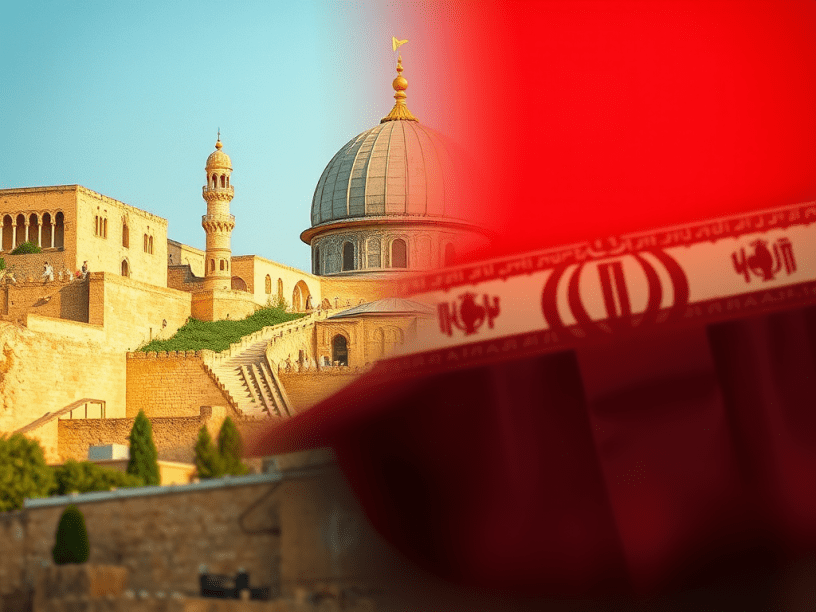
Elam (later known as Persia and Iran) was a powerful country thousands of years ago. We saw some of its military might in Genesis 14 where several kings served Chedorlaomer king of Elam for twelve years before rebelling against him. Chedorlaomer king of Elam along with three other kings made war with the armies of other nations in the Valley of Siddim (that is, the Salt Sea). Here’s how Genesis reports the battles:
“In the fourteenth year Chedorlaomer and the kings that were with him came and attacked the Rephaim in Ashteroth Karnaim, the Zuzim in Ham, the Emim in Shaveh Kiriathaim, and the Horites in their mountain of Seir, as far as El Paran, which is by the wilderness. Then they turned back and came to En Mishpat (that is, Kadesh), and attacked all the country of the Amalekites, and also the Amorites who dwelt in Hazezon Tamar. And the king of Sodom, the king of Gomorrah, the king of Admah, the king of Zeboiim, and the king of Bela (that is, Zoar) went out and joined together in battle in the Valley of Siddim against Chedorlaomer king of Elam, Tidal king of nations, Amraphel king of Shinar, and Arioch king of Ellasar—four kings against five. Now the Valley of Siddim was full of asphalt pits; and the kings of Sodom and Gomorrah fled; some fell there, and the remainder fled to the mountains. Then they took all the goods of Sodom and Gomorrah, and all their provisions, and went their way. They also took Lot, Abram’s brother’s son who dwelt in Sodom, and his goods, and departed.” Genesis 14:5- 12
That was Chedorlaomer king of Elam’s big mistake. He took Lot and his family captive. Lot was Abram the Hebrew’s nephew. Abram got together more than 300 of the servants who had been born into his household and pursued Chedorlaomer king of Elam and the other kings’ armies. Here’s how that confrontation ended:
“He divided his forces against them by night, and he and his servants attacked them and pursued them as far as Hobah, which is north of Damascus. So he brought back all the goods, and also brought back his brother Lot and his goods, as well as the women and the people.” Genesis 14:15-26
Some historians believe Abram and his servants killed the kings and their armies, though the death of Chedorlaomer is not mentioned. However, we do know that Chedorlaomer, the other kings and their armies fled from Abram and his servants, and were chased down to the point of Abram’s ‘forces’ being able to safely retrieve Lot, his family, and their stolen goods. The king of Sodom went out to meet Abram at the Valley of Shaveh (the King’s Valley), after what the Bible refers to as Abram’s ‘defeat of Chedorlaomer and the kings who were with him’ (Genesis 14:17). The next verses give us more insight into how Abram and a small group of servants could defeat the mighty armies of four nations:
“Then Melchizedek king of Salem brought out bread and wine; he was the priest of God Most High. And he blessed him and said: “Blessed be Abram of God Most High, Possessor of heaven and earth; And blessed be God Most High, Who has delivered your enemies into your hand.” Genesis 14:18-20
The victory belonged to God.
Israel at War
That has long been Israel’s story of defeating larger, more powerful armies. God fought the battles for them. You’ll find historical examples throughout the Old Testament. However, for the purpose of this series, we’re looking specifically at Iran and Israel at war. According to the Bible, how many times did they fight and how often did Israel win? Possibly just one time – Abram vs King Chedorlaomer.
Elam is rarely mentioned in the Bible. There are some exceptions, but not in the context of warring with Israel. God did show the prophet Ezekiel an interesting vision that mentioned Elam. Remember that Ezekiel the priest was captured by the Babylonian army in the early part of the 6th century BC and moved from Jerusalem to Babylon. Here’s what God showed Ezekiel about the future of Elam. This is in the context of visions of the future of many other nations as well:
“There is Elam and all her multitude, All around her grave, All of them slain, fallen by the sword, Who have gone down uncircumcised to the lower parts of the earth, Who caused their terror in the land of the living; Now they bear their shame with those who go down to the Pit. They have set her bed in the midst of the slain, With all her multitude, With her graves all around it, All of them uncircumcised, slain by the sword; Though their terror was caused In the land of the living, Yet they bear their shame With those who go down to the Pit; It was put in the midst of the slain.” Ezekiel 32:24-25
Other nations God said would be destroyed included Egypt, Assyria, Meshech, Tubal, and Edom. God also showed Ezekiel Judah’s punishment, though God would eventually restore His people to their land:
“For I will make the land most desolate, her arrogant strength shall cease, and the mountains of Israel shall be so desolate that no one will pass through. Then they shall know that I am the Lord, when I have made the land most desolate because of all their abominations which they have committed.” Ezekiel 33:28-29
God also showed Ezekiel how He would one day bring all of the children of Israel together under one great King – a King named ‘David’ even though David had been dead for hundreds of years:
“Again the word of the Lord came to me, saying, “As for you, son of man, take a stick for yourself and write on it: ‘For Judah and for the children of Israel, his companions.’ Then take another stick and write on it, ‘For Joseph, the stick of Ephraim, and for all the house of Israel, his companions.’ Then join them one to another for yourself into one stick, and they will become one in your hand. “And when the children of your people speak to you, saying, ‘Will you not show us what you mean by these?’— say to them, ‘Thus says the Lord God: “Surely I will take the stick of Joseph, which is in the hand of Ephraim, and the tribes of Israel, his companions; and I will join them with it, with the stick of Judah, and make them one stick, and they will be one in My hand.” And the sticks on which you write will be in your hand before their eyes. “Then say to them, ‘Thus says the Lord God: “Surely I will take the children of Israel from among the nations, wherever they have gone, and will gather them from every side and bring them into their own land; and I will make them one nation in the land, on the mountains of Israel; and one king shall be king over them all; they shall no longer be two nations, nor shall they ever be divided into two kingdoms again. They shall not defile themselves anymore with their idols, nor with their detestable things, nor with any of their transgressions; but I will deliver them from all their dwelling places in which they have sinned, and will cleanse them. Then they shall be My people, and I will be their God. “David My servant shall be king over them, and they shall all have one shepherd; they shall also walk in My judgments and observe My statutes, and do them. Then they shall dwell in the land that I have given to Jacob My servant, where your fathers dwelt; and they shall dwell there, they, their children, and their children’s children, forever; and My servant David shall be their prince forever. Moreover I will make a covenant of peace with them, and it shall be an everlasting covenant with them; I will establish them and multiply them, and I will set My sanctuary in their midst forevermore. My tabernacle also shall be with them; indeed I will be their God, and they shall be My people. The nations also will know that I, the Lord, sanctify Israel, when My sanctuary is in their midst forevermore.” Ezekiel 37:15-28
Interestingly enough it was Elam, known as the ‘Medes and Persians,’ that would free Judah from Babylonian captivity and allow them to return to Judah to rebuild Jerusalem and its Temple.
“Now in the first year of Cyrus king of Persia, that the word of the Lord by the mouth of Jeremiah might be fulfilled, the Lord stirred up the spirit of Cyrus king of Persia, so that he made a proclamation throughout all his kingdom, and also put it in writing, saying, Thus says Cyrus king of Persia: All the kingdoms of the earth the Lord God of heaven has given me. And He has commanded me to build Him a house at Jerusalem which is in Judah. Who is among you of all His people? May the Lord his God be with him, and let him go up!” 2 Chronicles 36:22-23
I would call that a ‘positive’ relationship between Judah (Israel) and Persia (Iran). Those freed Israeli captives who returned to Jerusalem did rebuild the Temple and the wall around the city of Jerusalem. Various kings of Persia helped Judah with military protection, money, and supplies. That’s a far cry from what we are seeing between Israel and Iran today.
Someone might bring up the war of the Jewish Hasmonean Empire against the Seleucid Empire. Israel rebelled against the Seleucid’s during the Maccabean revolt in the middle of the 2nd century BC. That led to a period of almost a century of independence for Israel until Rome occupied Jerusalem and took control in the middle of the 1st century BC.
So, was Israel’s revolt against the Seleucid Empire a war with ancient Elam/Persia/Iran? I don’t believe so. Why? Because the Seleucid Empire inherited parts of the former Persian empire that Alexander the Great had defeated. The Seleucid Empire was a Hellenistic Greek kingdom that promoted Greek culture. It was not culturally Persian, though some historians refer to it as a ‘two-world’ or ‘dual-world’ system. The kings and military were Greek, and the language and culture in the urban areas were Hellenized. However, some traditional culture blending with Greek culture was allowed to continue in areas.
Iran at War
As I’ve mentioned earlier in this series Israel ceased to be a nation after its defeat at the hands of the Romans in 70 AD. Israel did not become a nation again until 1948 AD, almost 1,900 years later. While individual Jews were victims of wars across the world between those years (e.g. 11th century AD Crusades; persecution in Europe for centuries leading up to World War II), most of the Persian empires treated Jews well. Keep in mind that only a minority of Jews returned to Israel after Persian King Cyrus freed them in the latter part of the 6th century BC. Though the Jewish religion, Judaism, was different from that of Persia’s (Zoroastrianism), Israelis were given protected status and lived in their own communities. That allowed them to follow their Hebrew laws and traditions.
That raises an important question. When did Persia/Iran begin to war against Jews? The Book of Esther concerns one plot against the Jews living under Persian rule during the 5th century BC, but that did not turn into a war against Israel. You will find some historical information about forced conversions of Jews during the Safavid Dynasty in Persia during the 16th, 17th, and 18th centuries AD. However, that doesn’t appear to rise to the status ‘war.’ There are historical reports of forced conversions of Jews during the 19th century AD, but that wouldn’t classify as a ‘war’ either.
The ‘trigger’ point was when Israel became a nation again in 1948. It started a war that involved several Arab nations against the new State of Israel:
“The Arab-Israeli War of 1948 broke out when five Arab nations invaded territory in the former Palestinian mandate immediately following the announcement of the independence of the state of Israel on May 14, 1948. In 1947, and again on May 14, 1948 … On the eve of May 14, the Arabs launched an air attack on Tel Aviv, which the Israelis resisted. This action was followed by the invasion of the former Palestinian mandate by Arab armies from Lebanon, Syria, Iraq, and Egypt. Saudi Arabia sent a formation that fought under the Egyptian command. British trained forces from Transjordan eventually intervened in the conflict, but only in areas that had been designated as part of the Arab state under the United Nations Partition Plan and the corpus separatum of Jerusalem. After tense early fighting, Israeli forces, now under joint command, were able to gain the offensive. Though the United Nations brokered two cease-fires during the conflict, fighting continued into 1949. Israel and the Arab states did not reach any formal armistice agreements until February. Under separate agreements between Israel and the neighboring states of Egypt, Lebanon, Transjordan, and Syria, these bordering nations agreed to formal armistice lines. Israel gained some territory formerly granted to Palestinian Arabs under the United Nations resolution in 1947. Egypt and Jordan retained control over the Gaza Strip and the West Bank respectively. These armistice lines held until 1967. The United States did not become directly involved with the armistice negotiations, but hoped that instability in the Middle East would not interfere with the international balance of power between the Soviet Union and the United States.” Office of the Historian, U.S. Department of State
Notice that Persia/Iran is not mentioned as one of the nations fighting with the new State of Israel. In fact, Iran was the second Muslim-majority country to recognize Israel (Turkey was first). Iran did so in 1950 under the leadership of Shah Mohammad Reza Pahlavi. The two countries cooperated with each other until the Pahlavi Dynasty ended in 1979 when a revolution ousted Mohammad Reza Shah Pahlavi and ended the Imperial State of Iran. Ayatollah Ruhollah Khomeini became the new leader of Iran who established the Islamic Republic of Iran (Persian: Nezâm-e Jomhuri-ye Eslâmi-ye Irân).
That began a new relationship between Iran and Israel. Iran cut all ties with Israel and looked at it as the ‘Little Satan’ and the United States as the ‘Great Satan.’ The new Iranian government has long denied the Holocaust and called for the ‘dissolution’ of the State of Israel.
Iran’s change in relationship to Israel led to its use of ‘proxies’ against Israel in what’s been called the ‘Axis of Resistance:’
“Axis of Resistance, loose and informal military network of militant groups, which bill themselves as resistance forces, and state-controlled armed forces in the Middle East that are supported by Iran and its Islamic Revolutionary Guard Corps (IRGC). In addition to the IRGC, the axis comprises Hezbollah in Lebanon, Hamas and the Palestinian Islamic Jihad (PIJ) in the Gaza Strip and the West Bank, certain militias in Iraq, and Houthi forces in Yemen. Until December 2024, when the government of Bashar al-Assad was toppled, the Syrian armed forces had been a key component of the axis and allowed unfettered access between Iran and the Mediterranean Sea. The name used by the network seems to have originated as a response to U.S. Pres. George W. Bush’s term “axis of evil,” which referred to Iraq under Saddam Hussein, Iran, and North Korea, nonaligned countries that the United States considered to be uniquely bellicose. The interests of the axis members are regional in scope, aligning with Iran (one of the most influential powers in the Middle East) in opposition to Israel and Saudi Arabia as well as the United States for its interference in the region’s balance of power. Each group in the network acts independently of one another and is motivated by its own self-interest, but the network coordinates in training, attaining weaponry, and supporting one another in achieving common goals.” Britannica
Hamas’ attack on Israel on October 7, 2023 (also known as the ‘Gaza War’) increased tensions between Iran and Israel. The conflict escalated to ‘direct’ exchanges in 2024 that included Iranian strikes on Israel using missiles and drones. Israel responded to those attacks with a combination of defensive responses including the ‘Iron Dome,’ ‘David’s Sling,’ ‘Arrow 2,’ ‘Arrow 3,’ and the ‘Iron Beam.’ That led to a 12-day war in June 2025 known as ‘Operation Rising Lion:’
“On June 13, 2025, Israel conducted a major operation against Iran. The anticipated attack, which targeted nuclear facilities, military sites, and regime infrastructure, followed nearly two years of war between Israel and Iran-backed militant groups that also saw two direct confrontations between Israel and Iran in 2024. As fighting increased on both sides, the United States got involved, targeting the most critical and fortified sites in Iran’s nuclear program, which Israel was unable to destroy with its own arsenal. A ceasefire was announced on June 24, bringing the 12-day war to an end.” Britannica
Iran launched renewed attacks in February 2026 in response to Israeli and U.S. strikes aimed at military sites in Iran. That is the ‘war’ we are watching now. Dozens of Iranian leaders have been killed in the attacks, including Iran’s Supreme Leader Ayatollah Ali Khamenei. Israel and the United States are continually bombing military targets in Iran. Iran has responded with missle and drone attacks on Israel and many of its Arab neighbors including Saudi Arabia and several ‘Gulf states.’ Hezbollah, an Iranian proxy, has also joined the current war against Israel by firing missiles at it from Lebanon.
Is This A Religious War?
I believe the simple answer is YES, but why? It’s interesting to note that the major nations involved in the current conflict all come from an Abrahamic faith. By that I mean those religions that look to Abraham as the ‘father’ of their monothestic belief system.
God called a polytheist (worshiping many gods) named Abram to leave his home in Ur of the Chaldees about four thousand years ago to become a monotheist (worshiping one God) and establish a special nation for God. God eventually changed Abram’s name to ‘Abraham’ (“your name shall be Abraham; for I have made you a father of many nations” Genesis 17:5). Abraham’s children included Ishmael, Isaac, Zimran, Jokshan, Medan, Midian, Ishbak, and Shuah. Muslims revere Ishmael as an ancestor of the Prophet Muhammad, while Jews revere Isaac as an ancestor of Jacob who God renamed ‘Israel’ (Genesis 32:28). Christians revere Abraham, Isaac, and Jacob as ancestors of the promised Messiah and Savior, Jesus the Christ.
From a political/war perspective:
- Iran – Majority Shiah Muslim nation
- Israel – Majority Jewish nation
- United States – Majority Christian nation
- Arab countries – Majority Sunni Muslim nations
Next Time
Thus, we see clearly that the current war in the Middle East has deep religious roots. What are those roots and how will they play out in this conflict? I’ll dig into those areas in the next part of my series, Iran and Israel at War.
Scripture taken from the New King James Version®. Copyright © 1982 by Thomas Nelson. Used by permission. All rights reserved.
Faith and Self Defense © 2026

 Faith & Self Defense