
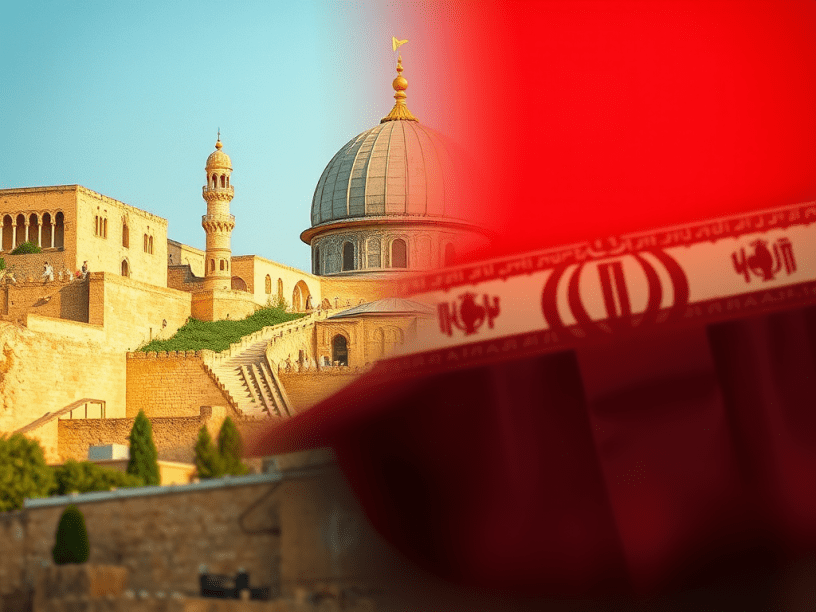
The war in the Middle East continues – Iran vs. Israel with the United States thrown in. What’s it about? Power. Position. Sovereignty. Kingdoms. Nations today like to use the terms ‘Democracy, Republic, Constitutional Government, Nation-state, Monarchy, etc.’ However, today’s nations are not much different than those that have existed for thousands of years. They are ‘kingdoms,’ whether they have a ‘king’ (queen) or not. Nations view themselves as having the ‘absolute right’ to rule their people and land according to their desire – whether for good or for bad. That’s the same thing we find throughout history.
As we’ve seen through millennia of history, nations come and go. Earthly kingdoms rise up, then disappear. Dozens of civilizations have risen and fallen since the beginning of time. Hundreds of tribal peoples have done the same. They appear, then disappear. Some last for decades. Some for centuries. But their end is in sight. So it will be for the nations we hear about across the world every day on the news. They may seem powerful and in control of events now, but their end is near.
However, there is one Kingdom that will last forever. It is the Kingdom of Almighty God. His Kingdom is everlasting because the King is everlasting. The problem is that Christians don’t understand how God views His own Kingdom. They get some things right, but so much wrong. Here are some things to consider.
The Kingdom of God
Many Christians disagree about what is meant in the Bible by the word ‘kingdom.’ Here are some examples from New Testament writers:
- the kingdom of God
- kingdom of heaven
- the everlasting kingdom
- the kingdom of Christ and God
- His kingdom,
- the everlasting kingdom of our Lord and Savior Jesus Christ.’
The Greek word for ‘kingdom’ is βασιλεία (basileia) and comes from the word βασιλεύς (basileus) which means ‘king.’ A ‘kingdom’ is ruled by a ruler, often called ‘king.’ Herod is listed as a ‘king’ in the New Testament. So is David. Jesus is called ‘the ruler over the kings of the earth’ in Revelation 1:5. He is also called ‘King of kings’ in Revelation 17:14. Revelation 11:15 reads: “The kingdoms of this world have become the kingdoms of our Lord and of His Christ, and He shall reign forever and ever!”
One of the mistakes Christians have made for centuries is to think that a word always means the same thing wherever it’s used in Scripture. Remember this rule of Bible study?
- Text
- Within Context
- In the Original Language
- To the Original Readers
Here are some examples.
Satan tested Jesus in the wilderness. The devil took the Lord to ‘an exceedingly high mountain, and showed Him all the kingdoms of the world and their glory. And he said to Him, ‘All these things I will give You if You will fall down and worship me.’ Then Jesus said to him, ‘Away with you, Satan! For it is written, ‘You shall worship the Lord your God, and Him only you shall serve.’ ” (John 18) Jesus did not question that Satan could give Him the ‘kingdoms of the world’ if He would fall down and ‘worship’ him. Jesus responded to the devil’s declaration by repeating Scripture about worshipping ‘the Lord your God’ only.
After Satan left Jesus and angels ‘ministered to Him,’ Matthew wrote that ‘Jesus began to preach and to say, “Repent, for the kingdom of heaven is at hand’ (Matthew 4:17). Matthew was the only apostle to use the phrase ‘kingdom of heaven.’ The other apostles used the phrase ‘kingdom of God.’ Is there a difference between the ‘kingdom of heaven’ and the ‘kingdom of God?’
Take a look at the words Mark used in his Gospel account for what Jesus said after His testing by Satan:
“The time is fulfilled, and the kingdom of God is at hand. Repent, and believe in the gospel.” Mark 1:15
Same situation, yet different terms. Here’s the Greek for each:
‘kingdom of heaven’ in Matthew’s Gospel account – βασιλεία τῶν οὐρανῶν
‘kingdom of God’ in Mark’s Gospel account – βασιλεία τοῦ Θεοῦ
Different words (heavens, God), so different meanings? The only way to know for sure is compare every usage of ‘kingdom of heaven’ in Matthew in the same context found in Mark, Luke, and John.
The Gospel writers quote Jesus using the term ‘kingdom’ scores of times. One of His best known sayings is part of what many Christians call ‘The Lord’s Prayer:’
“Your kingdom come. Your will be done On earth as it is in heaven.’ Matthew 6:10
“Your kingdom come. Your will be done On earth as it is in heaven.” Luke 11:2
Jesus taught His disciples to say that prayer, so it’s apparently something He believed to be true. Jesus wanted His followers to pray for God’s kingdom to ‘come’ so that His ‘will’ would be done on ‘earth as it is in heaven.’ This is what Jews believed should happen when Messiah came. He would rule the earth from the ‘throne of His father David’ (Luke 1:32).
Interestingly, this was an exchange Jesus had with Pilate during the Lord’s trial:
“Am I a Jew? Your own nation and the chief priests have delivered You to me. What have You done?’ Jesus answered, ‘My kingdom is not of this world. If My kingdom were of this world, My servants would fight, so that I should not be delivered to the Jews; but now My kingdom is not from here.’ Pilate therefore said to Him, ‘Are You a king then?’ Jesus answered, ‘You say rightly that I am a king. For this cause I was born, and for this cause I have come into the world, that I should bear witness to the truth. Everyone who is of the truth hears My voice.” John 18:35-37
Confused yet? Jesus started His ministry by calling Jews to repent because the ‘kingdom’ was ‘at hand.’ The Lord made many references to His judging the nations and ruling the earth (e.g. Matthew 25:31-32. Jesus even told His disciples that they would ‘rule’ the earth with Him:
“And I bestow upon you a kingdom, just as My Father bestowed one upon Me, that you may eat and drink at My table in My kingdom, and sit on thrones judging the twelve tribes of Israel.” Luke 22:29-31
In Peter’s sermon on Pentecost, he said this:
“Men and brethren, let me speak freely to you of the patriarch David, that he is both dead and buried, and his tomb is with us to this day. Therefore, being a prophet, and knowing that God had sworn with an oath to him that of the fruit of his body, according to the flesh, He would raise up the Christ to sit on his throne, he, foreseeing this, spoke concerning the resurrection of the Christ, that His soul was not left in Hades, nor did His flesh see corruption.” Acts 2:29-31
That sounds like Peter was preaching Christ’s ‘physical’ rule from David’s throne. Yet, when asked about His kingdom before going to the cross Jesus said His ‘kingdom’ was ‘not of this world.’ What are we not seeing here?
Remember the other four rules of Bible study:
- See Everything
- Ask Everything
- Answer Everything
- Interpret Everything
If we try to build an interpretation of ‘the kingdom’ by looking at a small number of Bible verses, some in the Old and some in the New Testaments, we will miss what God wants us to know about His Eternal plan.
The Gospel of the Kingdom
Will Jesus Christ return from Heaven to Earth and judge and rule the nations of the Earth? Absolutely! Jesus said it and demonstrated His supernatural ability to do that as He preached ‘the gospel of the kingdom:’
“And Jesus went about all Galilee, teaching in their synagogues, preaching the gospel of the kingdom, and healing all kinds of sickness and all kinds of disease among the people.” Matthew 4:23
“Then Jesus went about all the cities and villages, teaching in their synagogues, preaching the gospel of the kingdom, and healing every sickness and every disease among the people.” Matthew 9:35
The Apostle Peter clearly preached that Jesus would establish His ‘earthly kingdom’ when Israel repented and changed their mind (converted) about Jesus:
“But those things which God foretold by the mouth of all His prophets, that the Christ would suffer, He has thus fulfilled. Repent therefore and be converted, that your sins may be blotted out, so that times of refreshing may come from the presence of the Lord, and that He may send Jesus Christ, who was preached to you before, whom heaven must receive until the times of restoration of all things, which God has spoken by the mouth of all His holy prophets since the world began. For Moses truly said to the fathers, ‘The Lord your God will raise up for you a Prophet like me from your brethren. Him you shall hear in all things, whatever He says to you. And it shall be that every soul who will not hear that Prophet shall be utterly destroyed from among the people.’ Yes, and all the prophets, from Samuel and those who follow, as many as have spoken, have also foretold these days.” Acts 3:18-24
Notice that Peter referred to what Moses said to the children of Israel centuries earlier concerning the raising up of a ‘Prophet’ like Him from ‘among your brethren.’ Anyone who did not obey the Prophet would be ‘utterly destroyed from among the people.’ Then Peter said that all the prophets from Samuel onward had ‘foretold these days.’ THESE DAYS. Peter was saying clearly that Jesus was the Prophet that Moses said would come. Peter had already said that God ‘would raise up the Christ to sit on his throne’ (in the context of David’s throne – Acts 2:30).
As I’ve shared with you in previous parts of this series, using the word ‘gospel’ (good news) has to be viewed in its proper context. The same is true with the word ‘kingdom.’ To say the phrase ‘gospel of the kingdom’ doesn’t necessarily mean that every usage of the word ‘gospel’ always connects it to the earthly rule of Jesus Christ from Jerusalem. This is where many Christians have been confused for centuries, even to our own time.
Paul and the Kingdom
I have heard this for years: ‘but Paul spoke about the kingdom and that means Christ’s physical rule of the earth.’ It is true that the Apostle Paul wrote about ‘the kingdom,’ but was he preaching the same message as the other apostles? Remember that God entrusted Paul with the ‘gospel for the uncircumcised’ (non-Jews) even as God had entrusted the ‘gospel for the circumcised’ (Jews) to Peter. (Galatians 2) Could it be that the ‘kingdom’ they each mentioned might not be the same? Also remember that God made known a ‘mystery’ to Paul ‘by revelation’ which ‘in other ages was not made known to the sons of men.’ (Ephesians 3) That mystery was that Gentiles would be fellow heirs, of the same body, ‘and partakers of His promise in Christ through the Gospel.’ That good news came as quite a surprise to Peter and the other Jewish apostles as we have seen.
It’s important that we keep all of that in mind as we look at how the Apostle Paul wrote about the ‘kingdom of God.’ The Jews knew about the ‘kingdom’ God was going to establish for them centuries before Christ began His earthly ministry. However, the ‘mystery’ of how God would establish a ‘kingdom’ for the Gentiles was not known until He revealed it to the Apostle Paul. It is a kingdom that is part of the ‘inheritance’ Christians have from being members of the ‘Body’ of Christ. This very well could be what God showed Paul through ‘visions and revelations’ (2 Corinthians 12), but would not allow Paul to ‘express’ or describe. Here’s some of what Paul revealed to members of the Body of Christ years after he received those ‘visions and revelations’ from God:
- “the kingdom of God is not eating and drinking, but righteousness and peace and joy in the Holy Spirit.” Romans 14:17
- “the kingdom of God is not in word but in power.” 1 Corinthians 4:20
- “Do you not know that the unrighteous will not inherit the kingdom of God? Do not be deceived. Neither fornicators, nor idolaters, nor adulterers, nor homosexuals, nor sodomites, nor thieves, nor covetous, nor drunkards, nor revilers, nor extortioners will inherit the kingdom of God.” 1 Corinthians 6:8-10
- “Now this I say, brethren, that flesh and blood cannot inherit the kingdom of God; nor does corruption inherit incorruption. Behold, I tell you a mystery: We shall not all sleep, but we shall all be changed— in a moment, in the twinkling of an eye, at the last trumpet. For the trumpet will sound, and the dead will be raised incorruptible, and we shall be changed. For this corruptible must put on incorruption, and this mortal must put on immortality. So when this corruptible has put on incorruption, and this mortal has put on immortality, then shall be brought to pass the saying that is written: “Death is swallowed up in victory.’ ‘O Death, where is your sting? O Hades, where is your victory?’ The sting of death is sin, and the strength of sin is the law. But thanks be to God, who gives us the victory through our Lord Jesus Christ. Therefore, my beloved brethren, be steadfast, immovable, always abounding in the work of the Lord, knowing that your labor is not in vain in the Lord.” 1 Corinthians 15:50-58
- “He has delivered us from the power of darkness and conveyed us into the kingdom of the Son of His love, in whom we have redemption through His blood, the forgiveness of sins.” Colossians 1:13-14
- “But the Lord stood with me and strengthened me, so that the message might be preached fully through me, and that all the Gentiles might hear. Also I was delivered out of the mouth of the lion. And the Lord will deliver me from every evil work and preserve me for His heavenly kingdom. To Him be glory forever and ever. Amen!” 2 Timothy 4:17-19
Let us all add our ‘Amens’ with the Apostle Paul – “To Him be glory forever and ever. Amen!”
“Blessed be the God and Father of our Lord Jesus Christ, who has blessed us with every spiritual blessing in the heavenly places in Christ, just as He chose us in Him before the foundation of the world, that we should be holy and without blame before Him in love, having predestined us to adoption as sons by Jesus Christ to Himself, according to the good pleasure of His will, to the praise of the glory of His grace, by which He made us accepted in the Beloved. In Him we have redemption through His blood, the forgiveness of sins, according to the riches of His grace which He made to abound toward us in all wisdom and prudence, having made known to us the mystery of His will, according to His good pleasure which He purposed in Himself, that in the dispensation of the fullness of the times He might gather together in one all things in Christ, both which are in heaven and which are on earth—in Him. In Him also we have obtained an inheritance, being predestined according to the purpose of Him who works all things according to the counsel of His will, that we who first trusted in Christ should be to the praise of His glory. In Him you also trusted, after you heard the word of truth, the gospel of your salvation; in whom also, having believed, you were sealed with the Holy Spirit of promise, who is the guarantee of our inheritance until the redemption of the purchased possession, to the praise of His glory.” Ephesians 1:3-14
Next Time
It’s time to bring this series to an end. Please join me next time for the conclusion of Iran and Israel at War.
Scripture taken from the New King James Version®. Copyright © 1982 by Thomas Nelson. Used by permission. All rights reserved.
Faith and Self Defense © 2026

 Faith & Self Defense