
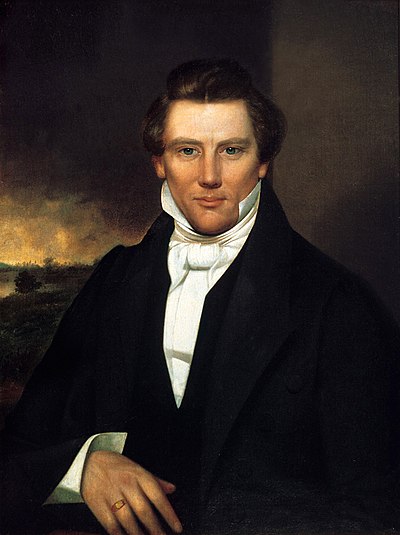
Even though I’ve written about Mormon beliefs many times before, I want to look at the religion from the aspect of questioning Joseph Smith, the founding prophet of the LDS church (Latter-Day Saints). Smith lived in the early part of the 19th century (1805-1844). Though I can’t question him directly, I can question his writings and those who follow and share his teachings.
Christian Questions / Mormon Answers
I mentioned in the last part of this series that Mormon missionaries often ask me to read portions of The Book of Mormon, which I do. In fact, I’ve read the entire book, along with other writings of Joseph Smith (e.g. Pearl of Great Price, Doctrines and Covenants, Joseph Smith Translation of the Bible) multiple times. Reading Smith’s writings always raises many questions. Though the words had a similar sound to the King James Bible (e.g. thee, thou, thine, etc), the words in the BOM (Book of Mormon) had been changed, rearranged, or added to the original text of the Bible. Mormons believe the Bible is the Word of God, “as far as it is translated correctly.” I’ll address that in a few minutes.
The early questions I raise to Mormons comes from an investigative process I call PPT — People, Places, Things. That’s the process I used when I was an atheist investigating the Bible. I would not have continued investigating the reliability of the Bible if it had not passed the PPT test. That’s how important it is in determining truth.
The PPT test is simple. As you read through pages in a document, especially one that purports to be historically accurate, make a note every time a person, place, or thing is mentioned. Then, research each one to see if there is any extra-source document or historical/anthropological/geographical/archaeological finding that supports the source claim. That’s what I did with the Bible. Because I found extra-biblical material that supported the PPT claims in the Bible, I kept reading. I found the Bible to be reliable in the areas of history, anthropology, geography, and archaeology. While that alone did not lead to my believing in God, it led me to Paul’s first letter to the Corinthians where he wrote —
Moreover, brethren, I declare to you the gospel which I preached to you, which also you received and in which you stand, by which also you are saved, if you hold fast that word which I preached to you—unless you believed in vain. For I delivered to you first of all that which I also received: that Christ died for our sins according to the Scriptures, and that He was buried, and that He rose again the third day according to the Scriptures, and that He was seen by Cephas, then by the twelve. After that He was seen by over five hundred brethren at once, of whom the greater part remain to the present, but some have fallen asleep. After that He was seen by James, then by all the apostles. Then last of all He was seen by me also, as by one born out of due time … Now if Christ is preached that He has been raised from the dead, how do some among you say that there is no resurrection of the dead? But if there is no resurrection of the dead, then Christ is not risen. And if Christ is not risen, then our preaching is empty and your faith is also empty. Yes, and we are found false witnesses of God, because we have testified of God that He raised up Christ, whom He did not raise up—if in fact the dead do not rise. For if the dead do not rise, then Christ is not risen. And if Christ is not risen, your faith is futile; you are still in your sins! Then also those who have fallen asleep in Christ have perished. If in this life only we have hope in Christ, we are of all men the most pitiable. 1 Corinthians 15:3-8, 12-19
The Apostle Paul, who was an enemy of Jesus and his disciples, became a disciple of Jesus Christ after a miraculous encounter with the risen Lord. The arch enemy of Christ became an apostle of Christ because of seeing Jesus for himself. Paul (Saul) knew that Jesus had died on a Roman cross. Paul lived in Jerusalem at the time of Jesus’ death. Paul was zealous in his efforts to arrest and punish the early followers of Jesus Christ. The fact that Paul became a follower of Jesus is a powerful witness in itself. Then there are hundreds of other people who also saw Jesus after He rose from the dead. Eye-witness testimony is often considered direct evidence in a trial, especially this type of eye-witness testimony. People actually saw the risen Jesus, talked with Him, touched Him, ate with Him, etc. That’s direct evidence to the reality that Jesus rose from the dead.
I tell Mormons that The Book of Mormon does not pass the PPT test. I can’t find the extra-source support (e.g. historical, anthropological, geographical, and archaeological) for the people, places, and things listed in the book. Part of the anthropological aspect is that DNA evidence doesn’t support the Mormon belief that native Americans were descendants of the Jews. I’m always careful to research the writings of Mormon scholars and scientists to see what they say in answer to these questions. I’ll share their findings as our series continues.
Mormon missionaries usually tell me that they don’t have answers to my questions, but that they rely on the feeling they receive from God’s Spirit that tell them The Book of Mormon is true. Some have told me that rather than rely on physical evidence, I should look to God for spiritual testimony to the truth of The Book of Mormon and other Mormon writings. I tell them that the spiritual testimony I have from God is that Mormon writings are not true. That’s the spiritual feeling I have after reading The Book of Mormon.
Trying to depend on feelings instead of what’s objectively true is a big problem. Why? Because lots of people from various and often conflicting religions say they have feelings about their religion being true. I share with Mormons the example of people with varying worldviews climbing a tall spiritual mountain from different sides with conflicting beliefs, only to arrive at the top and learn they had all reached the same position even with beliefs that conflict. I ask them if they think that’s logical or reasonable.
I continue by pointing to the logic that Jesus and His apostles used in presenting a seamless message about God’s promises from the Old Testament to the New Testament. One of the primary promises is the one God made to Eve in the Garden of Eden following her disobedience to God’s command.
And I will put enmity Between you and the woman, And between your seed and her Seed; He shall bruise your head, And you shall bruise His heel. Genesis 3:15
We can follow the “Seed” throughout the Bible to the virgin birth of Jesus. Jesus came from Heaven to earth for many reasons, but one of them was to “destroy the works of the devil” (1 John 3:8). That hearkens back to God’s promise in Genesis 3:15. After His resurrection, Jesus met with His disciples and taught them that what had happened to Him was part of His fulfilling Scripture —
Then He said to them, ‘These are the words which I spoke to you while I was still with you, that all things must be fulfilled which were written in the Law of Moses and the Prophets and the Psalms concerning Me.’ And He opened their understanding, that they might comprehend the Scriptures. Luke 24:44-45
Jesus taught His disciples God’s Word throughout their time together. He even told them they were going to Jerusalem where He would be betrayed and killed —
Now Jesus, going up to Jerusalem, took the twelve disciples aside on the road and said to them, ‘Behold, we are going up to Jerusalem, and the Son of Man will be betrayed to the chief priests and to the scribes; and they will condemn Him to death, and deliver Him to the Gentiles to mock and to scourge and to crucify. And the third day He will rise again.” Matthew 20:17-19
Jesus was a true Prophet. After His death and resurrection, Jesus met with His disciples and went deeper into how He was God’s fulfillment of the Seed promise. When Thomas doubted that Jesus had really raised from the dead, the disciples didn’t ask Thomas to believe based on feelings. They presented their eye-witness testimony – “We have seen the Lord” (Matthew 20:25). Thomas said he would not believe “Unless I see in His hands the print of the nails, and put my finger into the print of the nails, and put my hand into His side.” What did Jesus do? He appeared to Thomas eight days later and said – “Reach your finger here, and look at My hands; and reach your hand here, and put it into My side. Do not be unbelieving, but believing” (Matthew 20:27). Jesus presented Thomas with direct evidence. Thomas answered and said, “My Lord and my God!” (Matthew 20:28)
Peter did not appeal to spiritual feeling when he preached in the streets of Jerusalem on the Day of Pentecost. He appealed to the evidence from the Hebrew Scriptures (Acts 2). The same with the Apostle Paul when he spoke in Jewish synagogues across the Roman world —
Then Paul, as his custom was, went in to them, and for three Sabbaths reasoned with them from the Scriptures, explaining and demonstrating that the Christ had to suffer and rise again from the dead, and saying, ‘This Jesus whom I preach to you is the Christ. Acts 17:2-3
As I look at any religious text (as I did in A History of Man’s Quest for Immortality), my primary interest is in supportive evidence rather than how religious people feel about their religion. Mormons want me to have faith in the translations of Joseph Smith even when there’s little to no evidence to support it. If something is true, there will almost always be evidential support.
Next Time
That leads us to the next part of this series – Feelings vs Evidence. What’s the difference between the two and how does that affect Mormonism? Also, how does evidence against religious belief affect continued belief in that religion?
Scripture taken from the New King James Version®. Copyright © 1982 by Thomas Nelson. Used by permission. All rights reserved.
Faith and Self Defense © 2023

 Faith & Self Defense