
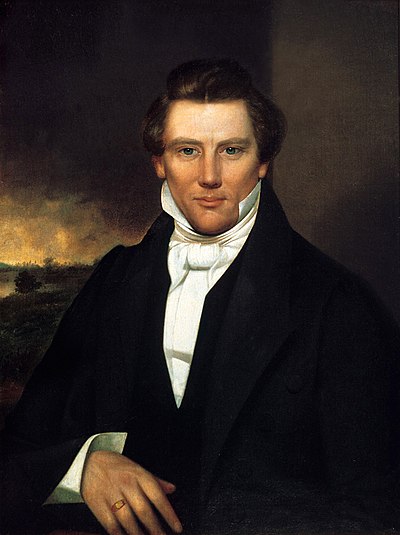
Mormons ask me to depend on spiritual feelings to believe in the teachings of Joseph Smith even when evidence is lacking or contradictory. As a career journalist, I find that very troubling.
I use a variety of proven investigative techniques when researching truth claims. Mormons claim that The Book of Mormon is the “most correct of any book on earth.” However, that claim doesn’t hold up under careful investigation. Even Mormon scholars struggle with the lack of evidence or contradictory evidence to the writings of Joseph Smith, the founding prophet of Mormonism.
People, Places, Things
PPT stands for People, Places, Things. It’s a simple investigative process of searching for evidence of truth claims concerning whether people, places, and things existed at a particular time. I used PPT as an atheist while investigating the truth claims of the Bible. The Bible held up very well during the investigation, which kept me searching for the truth that is in Jesus Christ.
Joseph Smith believed and taught that native Americans (Indians) are descendants of the Jews who left Jerusalem in 600 BC and sailed to the Americas. Smith wrote that The Book of Mormon “is a record of God’s dealings with ancient inhabitants of the Americas.” Is that true? What’s the evidence that supports the claim?
Here’s another truth claim from The Book of Mormon that Joseph Smith translated —
The book was written by many ancient prophets by the spirit of prophecy and revelation. Their words, written on gold plates, were quoted and abridged by a prophet-historian named Mormon. The record gives an account of two great civilizations. One came from Jerusalem in 600 B.C. and afterward separated into two nations, known as the Nephites and the Lamanites. The other came much earlier when the Lord confounded the tongues at the Tower of Babel. This group is known as the Jaredites. After thousands of years, all were destroyed except the Lamanites, and they are among the ancestors of the American Indians. The Book of Mormon, 1981, 2013 copyrights
The current copyrights for the copy of The Book of Mormon I have are 1981 and 2013. The original publication copyright is 1830. That means more than 150 years between the original publication and the current copyrights. The first copy of The Book of Mormon that I read was published before 1981 and some of the words in the translation have since changed. For example, the current BOM (Book of Mormon) uses the phrase “they are among the ancestors of the American Indians.” The earlier translation I read stated – “they are the principle ancestors of the American Indians.” There is a big difference between a people being “principle ancestors” to being “among the ancestors.” Why would the Mormon church make that change in its “most correct” book?
The headquarters for The Church of Jesus Christ of Latter-Day Saints (LDS, Mormons) is located in Salt Lake City, Utah. The following is from an article that ran in the Salt Lake Tribune in November 2007.
Many Mormons, including several church presidents, have taught that the Americas were largely inhabited by Book of Mormon peoples. In 1971, Church President Spencer W. Kimball said that Lehi, the family patriarch, was ‘the ancestor of all of the Indian and Mestizo tribes in North and South and Central America and in the islands of the sea.’ After testing the DNA of more than 12,000 Indians, though, most researchers have concluded that the continent’s early inhabitants came from Asia across the Bering Strait. With this change, the LDS Church is ‘conceding that mainstream scientific theories about the colonization of the Americas have significant elements of truth in them,’ said Simon Southerton, a former Mormon and author of Losing a Lost Tribe: Native Americans, DNA and the Mormon Church. ‘DNA has revealed very clearly how closely related American Indians are to their Siberian ancestors,’ Southerton said in an e-mail from his home in Canberra, Australia. ‘The Lamanites are invisible, not principal ancestors.‘
If true, that might help explain the change in wording for the current publication of The Book of Mormon. How do we discover the truth? One way is scientific investigation. Many Mormon scientists have investigated and found some of the claims untrue or at least scientifically doubtful. A Mormon attorney shared his concerns this way —
‘It’s very difficult. It is almost traumatizing,’ said Jose Aloayza, a Midvale, Utah, attorney and Peruvian native who likened facing this new reality to staring into a spiritual abyss. ‘It’s that serious, that real. I’m almost here feeling I need an apology. Our prophets should have known better. That’s the feeling I get’ (‘DNA Results Challenge Core Mormon Beliefs,’ Local News, Seattle Times, Aug. 14, 2004).
Faith vs Evidence
This quote from a Mormon scientist and scholar is interesting given the pressure of believing the writings of Joseph Smith even when the evidence to support them is compromised.
A spiritual witness is the only way to know the truthfulness of the Book of Mormon. Although DNA studies have made links between Native Americans and Asians, these studies in no way invalidate the Book of Mormon despite the loud voices of detractors (“A Few Thoughts From A Believing DNA Scientist,” by John M. Butler, Journal of Book of Mormon Studies, vol. 12, no. 1, 2003, p. 36).
Dr. Butler is a leading expert on forensic DNA profiling. He knows that DNA evidence contradicts many of the truth claims in the writings of Jospeh Smith. However, Dr. Butler is able to set aside the evidence against the writings of Joseph Smith and choose “a spiritual witness” as his way of knowing the truthfulness of the Book of Mormon. Why would a scientist and scholar come to that conclusion?
In light of Dr. Butler’s quote in the Journal of Book of Mormon Studies that a “spiritual witness is the only way to know the truthfulness of the Book of Mormon, ” I found this quote from him to be insightful —
Scholarship comes from a desire to master information on a particular subject and involves intense study with careful attention to detail. The depths of a topic under investigation are plumbed through diligent research and hard work. Often after a great deal of effort, the final product is usually a scholarly publication or presentation. Having gone through this process many, many times in my professional career on numerous topics, I would suggest that a testimony of the Gospel of Jesus Christ is subject to the same requirements: desire, diligence, and devotion to data collection and analysis, and the due process of time. For those with a desire to learn, the data are available. And most importantly, the Source is citable—“by the power of the Holy Ghost, [you] may know the truth of all things” (Moroni 10:5). Dr. John Butler, Witnesses of the Book of Mormon, 2010
The two quotes appear to be contradictory. Dr. Butler wrote of going through the “scholarly” process many times, yet believes in documents that are contradictory to his own findings as a forensic DNA profiler. I question the kind of scholarship that can look at evidence that contradicts a belief, yet continue to believe the belief. That would seem to be an example of “faith without evidence.”
Here are other Mormon (and former Mormon) scholars who have written about the subject —
While perhaps affording revisionist Book of Mormon studies a veneer of scientific respectability, these apologetic efforts to reinvent Lamanite identity face some formidable challenges . . . (“Reinventing Lamanite Identity,” by Brent Lee Metcalfe, Sunstone, March 2004, p. 20).
In contrast to this account, data from numerous molecular population genetic studies suggest that the ancestors of extant Native Americans came from Siberia. No genetic evidence specifically supports the hypothesis that Native Americans descended from Middle Eastern populations (“Now What,” by Trent D. Stephens, Sunstone, March 2004, p. 26).
With the significant number of studies that have already been conducted concerning the genetic profiles of extant Native American populations, it does not seem likely that additional studies of this kind will present new data that differ significantly from that already accumulated (“Now What?,” by Trent D. Stephens, Sunstone, March 2004, p. 27).
Our perspective is that of active members of the Church of Jesus Christ of Latter-day Saints who view the Book of Mormon as an accurate, correct account of actual historic events that occurred on the American continent. We are also biologists. . . . As biologists we accept the published data dealing with Native American origins and view those data as reasonably representing American-Asian connections. . . .
We propose that . . . the children of Lehi . . . [act] as leaven with bread. The leaven is, of necessity, only a small ingredient in bread, not the bread itself. We propose that the children of Lehi are the leaven of the Abrahamic covenant in the New World, unlikely to be detected by genetic analysis of modern New World inhabitants (“Who Are the Children of Lehi?” by D. Jeffrey Meldrum and Trent D. Stephens, Journal of Book of Mormon Studies, vol. 12, no. 1, 2003, p. 38).
The data accumulated to date indicate that 99.6 percent of Native American genetic markers studied so far exhibit Siberian connections” (Journal of Book of Mormon Studies, vol. 12, no. 1, 2003, p. 41).
Folk biological claims of an Israelite ancestry, a curse with a dark skin, and a whitening of dark-skinned Native American and Polynesian Mormons fail to stand up to scrutiny among scientifically literate Latter-day Saints (“Genetic Research a ‘Galileo Event’ for Mormons,” by Thomas W. Murphy and Simon Southerton, Anthropology News, February 2003, p. 20).
From a scientific perspective, the Book of Mormon’s origin is best situated in early nineteenth-century America, . . . The Book of Mormon emerged from an antebellum perspective, out of a frontier American people’s struggle with their god, and not from an authentic American Indian perspective (“Lamanite Genesis, Genealogy, and Genetics,” by Thomas W. Murphy, in American Apocrypha: Essays on the Book of Mormon, Signature Books, 2002, p. 68).
Anthropologists and archaeologists, including some Mormons and former Mormons, have discovered little to support the existence of these civilizations. Over a period of 150 years, as scholars have seriously studied Native American cultures and prehistory, evidence of a Christian civilization in the Americas has eluded the specialists. In Mesoamerica, which is regarded by Mormon scholars to be the setting of the Book of Mormon narrative, research has uncovered cultures where the worship of multiple deities and human sacrifice were not uncommon. These cultures lack any trace of Hebrew or Egyptian writing, metallurgy, or the Old World domesticated animals and plants described in the Book of Mormon (Losing a Lost Tribe: Native Americans, DNA, and the Mormon Church, Simon Southerton, Signature Books, 2004, Introduction, p. xiv-xv).
In fact, the DNA lineages of Central America resemble those of other Native American tribes throughout the two continents. Over 99 percent of the lineages found among native groups from this region are clearly of Asian descent. Modern and ancient DNA sample tested from among the Maya generally fall into the major founding lineage classes . . . The Mayan Empire has been regarded by Mormons to be the closest to the people of the Book of Mormon because its people were literate and culturally sophisticated. However, leading New World anthropologists, including those specializing in the region, have found the Maya to be similarly related to Asians (Losing a Lost Tribe, pp. 190-191).
The Brethren no doubt recognize that to change the way Mormons think about the Book of Mormon would bring disruption and turmoil and risk undermining the foundation on which many people have based their religious convictions. . . . Millions of members feel a familial bond with Father Lehi, an emotion that frequently plays a central role in people’s conversion to the church. The General Authorities are aware of just how deep-seated and crucial these feelings are in the processes of conversion and retention (Losing a Lost Tribe, p. 206).
It came as no surprise to most scientists to learn that the DNA of living indigenous Americans was most homologous with the DNA of Asians. Well before the structure of DNA had been determined, the Asian source had been accepted through the steady accumulation of over a century’s worth of research from many disciplines. It was, and still is, widely accepted that the first waves of colonization occurred around or before 14,000 years ago from Siberia by way of the Bering Strait (Losing a Lost Tribe, p. 73).
Simon Southerton, a plant geneticist, . . . resigned his position as bishop and withdrew his church membership. In Mar 2000, he published the story of his disillusionment on the Internet. [http://www.exmormon.org/whylft125.htm] He ‘failed to find anything that supported migration of Jewish people before Columbus” and found “no reliable scientific evidence supporting migrations from the Middle East to the New World.’ . . . Investigation of mitochondrial DNA of more than 5,500 living Native Americans reveals that 99.4% can be traced back to Asia primarily via maternal lineages known as A, B, C, D and X. Only 0.6% came from Africa or Europe, most likely after 1492. Lineages A through D are only found in Asia. While the X lineage also is found in Europe and the Middle East, Asian and American lineages have distinctive markers that indicate an ancient separation long before the events described in the Book of Mormon. Similar results from nearly 1,000 paternal lineages substantiate a Northeast Asian origin of American Indians. Likewise, approximately 99% of the Polynesians surveyed to date can trace their maternal lineages back to Southeast Asia. The other 1% almost certainly came from Europe in the recent past. . . .
Next Time
The Book of Mormon and other writings of Joseph Smith often contradict evidence concerning the “people” listed in Mormon writings. How about “places” listed in Mormon writings? What historical, anthropological, geographical, and archaeological support can we find to support them? How do Mormon apologists handle those types of questions? We’ll look at that in the next part of our series, Questioning Joseph Smith.
Scripture taken from the New King James Version®. Copyright © 1982 by Thomas Nelson. Used by permission. All rights reserved.
Faith and Self Defense © 2023

 Faith & Self Defense