
Church leadership officially and consistently distances itself from issues regarding Book of Mormon geography in order to focus attention on the spiritual message of the book … Church leaders have generally declined to give any opinion on issues of Book of Mormon geography. BYU Book of Mormon Geography
Most Mormon missionaries I’ve talked with through the years answer my questions about evidence that questions or contradicts The Book of Mormon and other writings of Joseph Smith (e.g. Pearl of Great Price, Doctrines and Covenants) by saying that the writings focus primarily on the “spiritual message.”
Many other religions say the same thing when questioned about lack of evidence or contradictory evidence for their sacred writings from history, anthropology, geography, or archaeology. Saying that a person should ignore evidence for a spiritual message is not helpful for many people, like myself.
When asked to review a map showing the supposed landing place of Lehi’s company, President Joseph F. Smith declared that the “Lord had not yet revealed it” (Cannon, p. 160 n.). In 1929, Anthony W. Ivins, counselor in the First Presidency, added, “There has never been anything yet set forth that definitely settles that question [of Book of Mormon geography]…. We are just waiting until we discover the truth” (CR, Apr. 1929, p. 16).
That response from Mormon leaders brings us to the issue of Mormon apologists. How do scholar apologists of Mormonism deal with questions of evidence concerning the writing and teaching of Joseph Smith.
Mormon Apologists
What do you think of when you hear the word “apologist?” Some people think it means a person who apologizes for their beliefs, but that’s not the meaning of the word. The word comes from the Greek word apologia (ἀπολογία), which means “a verbal defense, a speech in defense, a well-reasoned reply.” The Apostle Paul used the word many times in his speeches and letters.
Brethren and fathers, hear my defense before you now. Acts 22:1
My defense to those who examine me is this: 1 Corinthians 9:3
… just as it is right for me to think this of you all, because I have you in my heart, inasmuch as both in my chains and in the defense and confirmation of the gospel, you all are partakers with me of grace. Philippians 1:7
Some indeed preach Christ even from envy and strife, and some also from goodwill: The former preach Christ from selfish ambition, not sincerely, supposing to add affliction to my chains; but the latter out of love, knowing that I am appointed for the defense of the gospel. Philippians 1:15-17
God appointed Paul “for the defense of the gospel.” Paul was often in prison “in the defense and confirmation of the gospel.” When people accused or questioned Paul, he gave them a well-reasoned speech in defense of what he believed. Defending verbally or in writing what we believe is the purpose of apologetics.
What then about Mormon apologists? If the official position of their church leadership is to officially and consistently distance itself “from issues regarding Book of Mormon geography in order to focus attention on the spiritual message of the book,” then what is the need for apologists in Mormonism?
Here is an official position of the Church of Jesus Christ of Latter-Day Saints concerning The Book of Mormon geography —
The Book of Mormon includes a history of an ancient people who migrated from the Near East to the Americas. This history contains information about the places they lived, including descriptions of landforms, natural features, and the distances and cardinal directions between important points. The internal consistency of these descriptions is one of the striking features of the Book of Mormon.
Since the publication of the Book of Mormon in 1830, members and leaders of The Church of Jesus Christ of Latter-day Saints have expressed numerous opinions about the specific locations of the events discussed in the book. Some believe that the history depicted in the Book of Mormon—with the exception of the events in the Near East—occurred in North America, while others believe that it occurred in Central America or South America. Although Church members continue to discuss such theories today, the Church’s only position is that the events the Book of Mormon describes took place in the ancient Americas. The Church of Jesus Christ of Latter-Day Saints
What did Joseph Smith believe about the geography of The Book of Mormon?
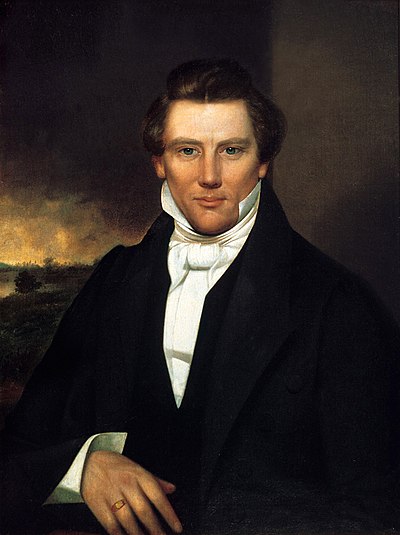
The Prophet Joseph Smith himself accepted what he felt was evidence of Book of Mormon civilizations in both North America and Central America. While traveling with Zion’s Camp in 1834, Joseph wrote to his wife Emma that they were “wandering over the plains of the Nephites, recounting occasionally the history of the Book of Mormon, roving over the mounds of that once beloved people of the Lord, picking up their skulls and their bones, as a proof of its divine authenticity.”1 In 1842, the Church newspaper Times and Seasons published articles under Joseph Smith’s editorship that identified the ruins of ancient native civilizations in Mexico and Central America as further evidence of the Book of Mormon’s historicity.
The Prophet Joseph Smith himself accepted what he felt was evidence of Book of Mormon civilizations in both North America and Central America. While traveling with Zion’s Camp in 1834, Joseph wrote to his wife Emma that they were “wandering over the plains of the Nephites, recounting occasionally the history of the Book of Mormon, roving over the mounds of that once beloved people of the Lord, picking up their skulls and their bones, as a proof of its divine authenticity.” In 1842, the Church newspaper Times and Seasons published articles under Joseph Smith’s editorship that identified the ruins of ancient native civilizations in Mexico and Central America as further evidence of the Book of Mormon’s historicity. The Church of Jesus Christ of Latter-Day Saints
What do church leaders think about that?
The Church does not take a position on the specific geographic locations of Book of Mormon events in the ancient Americas. Speculation on the geography of the Book of Mormon may mislead instead of enlighten; such a study can be a distraction from its divine purpose. The Church of Jesus Christ of Latter-Day Saints
Notice that the official position of Mormon leaders is that a study on the geography of the Book of Mormon “may mislead instead of enlighten” and could be “a distraction from its divine purpose.” While that might appear to hamper attempts by Mormon apologists to “defend” (apologia) the Book of Mormon and other sayings and writings of Joseph Smith, it depends what type of defense Mormons use.
Types of apologetics range from Fideism and Presuppositionalism to Classical apologetics and Evidentialism.
- Fideism is basically faith that is independent of or even opposed to reason. A fideist would say that a person should not look to evidence for religious belief.
- Presuppositionalism begins with a presupposition that God exists, that He is the God of the Bible, and that all truth comes from God
- Classical apologetics is the process of proving theism, then Christianity. I came from atheism to Christianity by way of Classical apologetics – theistic arguments followed by Christian evidences,
- Evidentialism is the process of using evidence to prove the truth claims of theism and Christianity.
There are several other types of apologetic methods, but these four help us understand the range of thinking in defending a particular religious perspective or worldview.
It’s interesting to note that Mormons often refer to C.S. Lewis, a leading Christian apologist, when talking or writing about apologetics.
C.S. Lewis pointed out that since enemies have invoked ‘science’ or ‘reason’ to attack faith, it may now be necessary that someone respond in the same vein. Mormonism and Apologetics
Some Mormons believe that apologetics is a waste of time since religion can’t be proven. However, some Mormon scholars have spoken to these concerns. Here are responses from Mormon scholars Dallin H. Oaks and Neal A. Maxwell —
The lack of decisive scientific proofs of scriptural truths does not preclude gospel defenders from counterarguments of that nature. When opponents attack the Church or its doctrines with so-called proofs, loyal defenders will counter with material of a comparable nature to defend.
There will be a convergence of discoveries (never enough, mind you, to remove the need for faith) to make plain and plausible what the modern prophets have been saying all along…[I] do not expect incontrovertible proof to come in this way…, but neither will the Church be outdone by hostile or pseudo-scholars. Mormonism and Apologetics
As I’ve mentioned before, Mormon missionaries admit that they don’t have answers to most of my questions about evidence that supports the truth claims of Mormonism – especially in the areas of history, geography, anthropology, and archaeology. However, they often point me to the writings and videos of Mormon apologists. One of the recommended apologists is Hugh Nibley (1910-2005). He was a Mormon scholar who taught at Brigham Young University (BYU) for almost 50 years. Some commentators have said that while B.H. Roberts was the greatest Mormon apologist of the first half of the 20th century, Hugh Nibley was foremost during the second half.
Next Time
In light of LDS church leaders generally declining to give any opinion on issues about Book of Mormon geography, we’ll look at what two of Mormonism’s top apologists taught about that geography. We’ll also compare their views to those of founding prophet Joseph Smith.
Scripture taken from the New King James Version®. Copyright © 1982 by Thomas Nelson. Used by permission. All rights reserved.
Faith and Self Defense © 2023

 Faith & Self Defense