
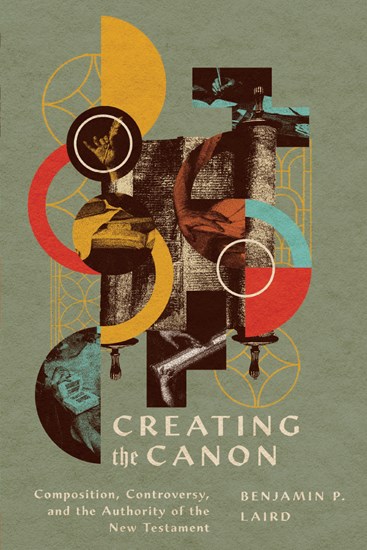
Creating the Canon: Composition, Controversy, and the Authority of the New Testament by Benjamin P. Laird (IVP Academic, 2023) is a challenging read, in all the right ways.
A Canon is – “an authoritative list of books accepted as Holy Scripture” (Merriam-Webster). Christians would know it as the “Bible.” The Canon of Christian Scripture includes Hebrew and Aramaic writings (Old Testament), and Greek writings (New Testament). Question is – how did we get them and how can we be sure what we have is true and complete.
That’s what Dr. Benjamin Laird (Ph.D) addresses in his new book. He stated one challenge facing anyone who wants answers to the questions raised above:
The study of ancient book culture and literary conventions are heavily specialized academic fields that are largely unfamiliar to contemporary readers of the Bible. Other than a small handful of postgraduate students and academics who have the patience and inclination to study technical works that address obscure literary practices from antiquity, few contemporary readers are familiar with the basic process by which ancient works were commonly composed, assembled, and distributed. Chapter One, p. 12
How did the Old Testament prophets and New Testament apostles write what we know as the Bible? And, how do we know that some ancient writings weren’t left out of what we consider the Biblical Canon today? Is the Canon of Scripture simply a work of individuals, or did God direct the process?
Professor Laird does the heavy lifting for you. He explains in great detail how ancient people communicated through writing. That’s good to know because real, flesh-and-blood people wrote what is now known as the Bible, the Word of God. Can we trust what they wrote?
Dr. Laird believes we can and lays out the case for a God-inspired Canon very well. He is honest about the ancient processes, the many challenges there have been (and continue to be) to the Canon of Scripture, and how Christians can trust the translations of ancient writings to be what they claim to be – the Word of God.
I especially appreciated the time Professor Laird spent on how the “apostolic” and “early” Church Fathers viewed the Gospels, Acts, and apostolic writings. They were not tricked into believing the many false gospels and heretical writings of the 2nd and 3rd centuries. Some of them knew the apostles personally; others knew the disciples of the apostles. What they wrote about the authenticity of the writings we look to as Scripture is most helpful in both a practical and apologetic sense.
Our investigation will begin with an exploration of various subjects that relate to the composition of the writings and will then transition to an assessment of the likely process that led to the creation of discrete canonical collections, a process that eventually led to the establishment and recognition of a single collection known today as the New Testament. Introduction, p. 5
I appreciate that Dr. Laird viewed his process through the lens of an “investigation.” I used the same lens as an atheist more than 50 years ago when I asked the same questions about the ‘Canon’ of Scripture. What I discovered helped me to believe in the existence of God, the credibility of Scripture, and the reality of the life, death, and resurrection of Jesus Christ.
I believe you will find Creating the Canon to be stimulating, insightful, and helpful. Whether you have your own concerns about the authority of Scripture or you are helping others with their doubts and concerns, Professor Laird’s book will be a great resource for you.
Contents
Abbreviations
Introduction
Part One: Questions Relating to the Composition of the New Testament Writings
1. The Composition of the New Testament Writings
2. The Original Autographs of the New Testament Writings
3. The Original Readers of the New Testament Writings
Part Two: Questions Relating to the Formation of the New Testament Canon
4. Theological Controversies and the Formation of the New Testament Canon
5. The Primary Witnesses to the Early State of the New Testament Canon
6. The Canonical Sub-Collections and the Formation of the New Testament Canon
Part Three: Questions Relating to the Authority of the New Testament Canon
7. Apostolicity and the Formation of the New Testament Canon
8. Apostolic Authorship and the Authority of the New Testament Canon
Bibliography
Indexes
[From IVP Academic Website]
Publisher Notes
Despite the profound influence of the New Testament, a variety of questions related to its background and history remain common. Contemporary readers often find the subject of the canon’s origin and formation to be complicated and confusing, while scholars continue to struggle to find agreement about basic elements of the canon’s development. In this engaging study, Benjamin P. Laird explores several misunderstood, disputed, and overlooked topics in order to provide fresh insight and clarity about the canon’s creation and modern relevance. The volume addresses questions such as:
- Was there a single “original autograph” of each New Testament writing?
- Who exactly were the “original readers” of the New Testament writings?
- Did theological controversies play a decisive role in prompting the canon’s formation?
- How did such a diverse body of writings come together to form a single canonical collection?
- Is there a basis for the canon’s ongoing authority?
Wide-ranging yet accessible, Creating the Canon offers an illuminating treatment of the composition, formation, and authority of the New Testament and serves as a valuable guide to those with limited prior study.
[From IVP Academic Website]
Reviews
“Benjamin Laird has written an insightful and helpful introduction to how we got the New Testament. Laird explains everything from ancient writing practices to book production and publication to letter writing in antiquity, as well as the origins and reception of Christian texts, and the importance of apostolic authority. A helpful read for anyone interested in the what and the how of the Bible.”
Michael F. Bird is academic dean and lecturer in New Testament at Ridley College in Melbourne, Australia
“Creating the Canon is a dependable guide for the early formation of the New Testament. It not only introduces the major scholarly voices in the debate, it also is structured to answer several common questions regarding the composition, formation, and the authority of the New Testament. Though the questions are common, Laird does not merely offer simple answers; rather, his work engages insights from textual criticism and canon research to address the origin, extent, and authority of the canon. Accessible to the student, yet filled with insights for teachers and scholars, Laird’s volume will be a helpful reference tool for many and provide a gateway into deeper canon studies for others—highly recommended!”
Darian R. Lockett, professor of New Testament at Talbot School of Theology, Biola University
“For those who wrestle with the nature and significance of the scriptural canon in modern Christianity and wonder about its ancient origins, Benjamin Laird’s book cuts a lucid and engaging path through many aspects of the canon’s composition, formation, and authority. Laird writes both as a historian and as a Christian, combining critical attention to sources and hermeneutics with a personal sense of the importance of these questions today.”
Jane Heath, Durham University
“As one treks into the rugged terrain of New Testament canon studies, a daunting range of issues looms on the horizon. Benjamin Laird maps out the general contours of current scholarship and then proposes his own path forward. His study provides a panoramic view of canon-related considerations but also raises significant questions concerning the relationship between apostolicity and the ecclesial recognition of divinely inspired texts.”
Paul A. Hartog, professor of theology at Faith Baptist Seminary
“The wonderful thing about studying the origins of the New Testament canon is that there’s always more to discover. It seems like a well without a bottom. This new volume by Benjamin Laird exemplifies this reality. In this wide-ranging study, Laird not only revisits older questions but also explores newer ones, creating a fresh and helpful addition to the growing body of work on the origins of the canon.”
Michael J. Kruger, president and Samuel C. Patterson Professor of New Testament at Reformed Theological Seminary in Charlotte, North Carolina
“If you are a follower of Christ, then you need to know where your New Testament came from. The New Testament—why it looks and reads the way it does—is the theme of this excellent book by Benjamin Laird. The author explores textual criticism, inerrancy, pseudonymity, apostolicity, and many other topics that are highly relevant for anyone wanting to read and understand their New Testament. I cannot recommend this work highly enough.”
David Alan Black, Southeastern Baptist Theological Seminary
“Creating the Canon tackles a difficult yet vital topic: the origin and reception of the Christian canon of Scripture. I am very impressed with how Dr. Laird explores, evaluates, and neatly lays out the options in a fair and balanced way. Whatever view one takes, one will learn a great deal about a complicated and essential dimension of the history of Christian faith and teaching. Highly recommended.”
Craig A. Evans, John Bisagno Distinguished Professor of Christian Origins at Houston Christian University
About the Author
Benjamin P. Laird (PhD, University of Aberdeen) is associate professor of biblical studies at the John W. Rawlings School of Divinity at Liberty University. His recent publications include The Pauline Corpus in Early Christianity, 40 Questions about the Apostle Paul, Five Views on the New Testament Canon, and the forthcoming The New Testament Canon in Contemporary Research. He lives in Lynchburg, Virginia, with his wife and five children.
[From IVP Academic Website]
Read an excerpt of this book
Creating the Canon: Composition, Controversy, and the Authority of the New Testament by Benjamin P. Laird (IVP Academic, 2023, 272 pages)
© Faith & Self Defense, 2023

 Faith & Self Defense