
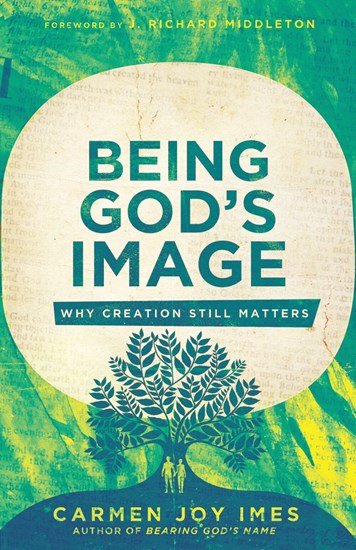
It’s not often that the author of a book ‘warns’ readers about reading their book, but Carmen Joy Imes does just that in her new book, Being God’s Image: Why Creation Still Matters (IVP Academic, 2023).
“It’s likely that I won’t say exactly what you are hoping I’ll say. If you’re especially offended, you may even burn this book.” Chapter 1, p. 11
That does seem unusual, but after reading the book I understand why she opened the first chapter that way. I don’t recommend ‘burning’ the book. I do think it’s worth a slow and thoughtful read. It’s not a difficult book to read in the sense of language or style, but it is challenging in other ways.
J. Richard Middleton wrote the Foreword to the book –
You could think of Being God’s Image as a primer in biblical theology, but one directed especially to lay Christians, You don’t need to be a theologian or a pastor to understand Carmen’s lucid writing. Yet Carmen has sneakily woven serious biblical scholarship into what seems to be a breezy, conversational book addressed to ordinary readers. Foreward, p. xii
The Challenge
Being God’s Image takes on what has become in many Christian circles one of the most controversial topics – Creation; especially God’s creation of the planet earth and of human beings made in His ‘image.’ I wouldn’t have thought when I became a Christian from atheism more than 50 years ago that Genesis chapters one and two would be so controversial, but that’s what’s happened during the last five decades. The disagreements were probably always there, but I didn’t know or care about them as an atheist. Once I became a follower of Jesus Christ, I cared.
My challenge reading the book was not stopping when I disagreed with something the author wrote. I agreed with enough to keep me going, plus I wanted to give the book an honest review. It’s hard to do that if I don’t finish a book. Right? So, if you run into some things that bother you, keep reading. You will find some things you will enjoy.
It’s obvious that the author, Carmen Joy Imes (PhD, Wheaton), loves God, Jesus Christ, humans, and the planet Earth. The fact that she is an associate professor of Old Testament at Biola University (where I studied apologetics) also interested me. Imes has a good grasp of the Hebrew language, which I appreciate when someone wants to tell me what they think about something in the Old Testament.
I disagree with some of her points and some of the authors she quoted, but I think having your own beliefs challenged can be a good thing. Christians need to know ‘why’ they believe ‘what’ they believe. We need to be able to defend our thinking critically, whether with unbelievers or believers.
My Take
In case you’re thinking I didn’t like the book, let me dissuade you from thinking that. I enjoyed much of it. One of my favorite chapters was The Human Project (chapter 4). I marked several portions because of the truthfulness of the author’s perspective. Here are several examples – the first from Chapter 3.
If we took seriously the Bible’s teaching that every human being is God’s image, it would radically reshape the way we think about and interact with others. The doctrine of the imago Dei needs shoe leather. Chapter 3, p. 57
East of Eden, life is ruthless. The human project continues and expands amid strife. Cain finds a wife and has children. He builds a city. His great-great grandson Lamech dominates his home, takes multiple wives, and brags about violent vengeance that is out of proportion to the crime against him (Genesis 4:19-24). He twists the story of his ancestor Cain, finding justification for murder. The narrator does not hold Lamech up as an example of someone who fulfills God’s purpose for creation. Quite the opposite. His story illustrates how quickly things ran amok.
Yet, we also get glimmers of hope. God granted Adam and Eve another son, Seth, in the wake of their grief over Abel. And by the time their grandsons were born, “people began to call on the name of the Lord” (Genesis 4:26). Not everyone was swept up into violence. Chapter 4, p. 59
Instead of telling us how many years Enoch lived, we’re told how long he “walked faithfully with God” (Genesis 5:22). Enoch’s life was characterized by much more than survival. He was an example of faithfulness in his generation. He was grounded. So remarkable was his life that rather than receiving a death report, we’re told, “then he was no more, because God took him away” (Genesis 5:24). Enoch modeled a different way to be human. Chapter 4, pp. 59-60
The bottom line is order. As I explained in chapter one, Genesis 1 depicts creation as a process of bringing disorder into order. God arranges the proper domains of every living thing so that each can flourish and be fruitful. Genesis 6 represents a willful breakdown in the order God established. Chapter 4, p. 61
Read the book. I think you’ll enjoy the challenge and learn much along the way.
Publisher’s Description
What does it mean to be human? This timeless question proves critical as we seek to understand our purpose, identity, and significance. Amidst the many voices clamoring to shape our understanding of humanity, the Bible reveals important truths related to our human identity and vocation that are critical to the flourishing of all of creation.
Carmen Joy Imes seeks to recover the theologically rich message of the creation narratives starting in the book of Genesis as they illuminate what it means to be human. Every human being is created as God’s image. Imago Dei is our human identity, and God appointed humans to rule on God’s behalf. Being God’s Image explores the implications of this kinship relationship with God and considers what it means for our work, our gender relations, our care for creation, and our eternal destiny. The Bible invites us into a dramatically different quality of life: a beloved community in which we can know God and one another as we are truly known.
Includes a discussion guide for personal reflection or group study, as well as links to related video material through the BibleProject. (IVP Website)
CONTENTS
Foreword
Introduction
Part 1: Humans in God’s World
1. Pattern of Creation
2. Crown of Creation
3. Shoe Leather
4. The Human Project
Interlude: Being the Image and Bearing the Name
Part 2: The Way of Wisdom
5. The Human Quest
6. Human Suffering
Part 3: Human in God’s New World
7. Jesus, the Human
8. A New Humanity
9. The Beloved Community
10. From Creation to New Creation
Conclusion
Acknowledgments
Discussion Questions
Bible Project Videos
Index
Endnotes
Read an excerpt.
About The Author
Carmen Joy Imes (PhD, Wheaton) is associate professor of Old Testament at Biola University. A graduate of Gordon-Conwell Theological Seminary, she is the author of Bearing God’s Name: Why Sinai Still Matters, Bearing YHWH’s Name at Sinai and the editor of Praying the Psalms with Augustine and Friends. Imes is a regular contributor to The Well, a fellow of Every Voice, and serves on the advisory council for the Bible Literacy Conference. She is a member of the Evangelical Theological Society and the Society of Biblical Literature and serves on the board of directors of the Institute for Biblical Research. (IVP Website)
Reviews
“Because of Carmen Imes’s warm and inviting prose, readers might not initially realize what a biblical narrative tour de force they receive in this book. From Genesis to Revelation, creation to new creation, Imes leaves no major challenging question unaddressed as she explores the central assertion that all humans are made in God’s image. A wise and able guide, Imes brings clarity, encouragement, and challenge herself as well as introducing numerous other guides so readers can press deeper. Along with Bearing God’s Name, Being God’s Image will stand as an influential Christian theology of creational flourishing.”
Amy Peeler, associate professor of New Testament at Wheaton College and Graduate School
“To really know who you are, you need to know where you came from. Carmen Imes takes this idea seriously and walks through Genesis and other parts of Scripture to capture God’s plan for creation, especially human image bearers. If you are looking for wisdom on personal identity and calling—and how to love, respect, and partner with fellow humans—this is a steady guide.”
Nijay K. Gupta, professor of New Testament at Northern Seminary
“This insightful, beautifully written book not only provides profound theological depth, it invites us into an all-of-life, practical discipleship that is deeply invested in the flourishing of creation. I’m so grateful for Carmen Imes’s wisdom, scholarship, and compelling vision of what it means to be human.”
Dominic Done, author of Your Longing Has a Name and When Faith Fails: Finding God in the Shadow of Doubt
“In this companion to Bearing God’s Name, Carmen Imes offers a brilliant and compelling study of the imago Dei. While Bearing God’s Name accents the unique vocation of God’s people, Being God’s Image foregrounds the remarkable status, dignity, and value that all humanity shares. Being is not divorced from bearing, but the distinction matters—in particular when thinking about gender, disability, race, suffering, and community. As readers sit at the table enjoying a rich biblical-theological feast, they’re treated to the stories and people from Imes’s journey who reflect the variegated light and life of the One in whose image we all are made.”
Matthew Lynch, associate professor of Old Testament at Regent College and author of Flood and Fury: Old Testament Violence and the Shalom of God
“Being God’s Image is a useful guide for Christians to see how the Bible explains what it means to be human. By engaging with a range of scholarship and writing with straightforward prose, Carmen Imes paints a hopeful picture in which we may recognize our true selves and be encouraged to live in harmony with our Creator and with others.”
Dennis R. Edwards, dean of North Park Theological Seminary
“Beautifully written and clearly presented, Being God’s Image takes the reader on a wonderful journey through Scripture. Carmen Imes clearly displays the wonder of being the creatures called to be God’s image and bear his name, reminding us throughout what an amazing thing it is to be made in the image of God.”
Marc Cortez, professor of theology at Wheaton College and Graduate School
“Carmen Imes succeeds in working through a ‘Bible from end to end’ treatment of the notion of humans as God’s image, and then takes the reader further by considering that notion in the larger context of creation as a whole. Being God’s Image is thorough yet accessible, and readers will further benefit from the insightful, natural sidebars Imes sprinkles throughout the book. Never chiding, she deftly navigates common points of Christian division, and in doing so crafts a work of important biblical scholarship that will be of great benefit to a wide swath of Christian readers.”
Matt Whitman, creator and host of The Ten Minute Bible Hour
“The image of God is one of the most foundational ideas in the biblical story and in Christian faith. But it’s a dense, multilayered concept with huge implications for how we understand humanity’s role in the world and in relationship to God. Carmen Imes has given us an accessible and profound exploration of this most important biblical theme. She not only shows what this idea meant in its ancient biblical context but also how it leads into the story of Jesus and the mission of his followers still today.”
Tim Mackie, cofounder of the BibleProject
“Carmen Imes, once again, takes a stock Christian concept—the image of God—and reveals how it is woven into the fabric of the biblical authors’ imaginations. Imes has a rare gift for helping the church to see the beauty and sophistication of the intellectual world of the Bible in plain language. Far from abstract speculation, she grounds us in the nitty-gritty mission of God to the world and how being God’s image directly affects communities and daily lives. The deep structures of Scripture come alive in her capable hands. This is the content I’m here for!”
Dru Johnson, associate professor of biblical and theological studies at The King’s College and author of Biblical Philosophy: A Hebraic Approach to the Old and New Testaments
“You could think of Being God’s Image as a primer in biblical theology, but one directed especially to lay Christians. You don’t need to be a theologian or a pastor to understand Carmen’s lucid writing. Yet Carmen has sneakily woven serious biblical scholarship into what seems to be a breezy, conversational book addressed to ordinary readers.”
J. Richard Middleton, professor of biblical worldview and exegesis at Northeastern Seminary, from the foreword
Being God’s Image: Why Creation Still Matters (Carmen Joy Imes, IVP Academic, 2023)
Copyright, © 2024, Faith and Self Defense
 Faith & Self Defense