
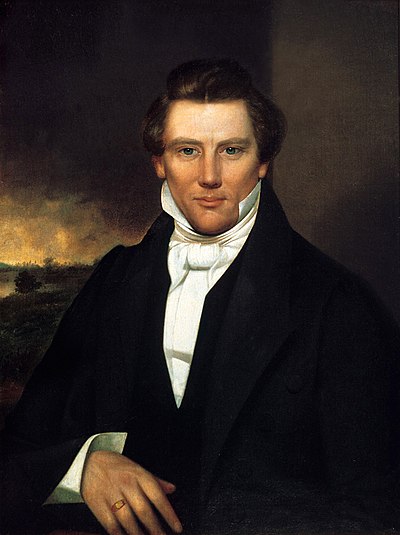
I told the brethren that the Book of Mormon was the most correct of any book on earth, and the keystone of our religion, and a man would get nearer to God by abiding by its precepts, than by any other book.” History of the Church, 4:461
According to church history Joseph Smith made that statement to a group of Mormon leaders on November 28, 1841. Smith was the founding prophet of Mormonism and the translator of the Book of Mormon. Smith believed the Book of Mormon was even more correct than the Bible. Is that true? Is the Book of Mormon more correct than the Bible?
Joseph Smith and the Bible
There are many things in the Bible which do not, as they now stand, accord with the revelations of the Holy Ghost to me. Joseph Smith, Teachings of the Prophet Joseph Smith, 310
Look at these words carefully. Joseph Smith is judging the validity of the Bible based on personal revelations he received from God. True or false? Did the Holy Spirit give Smith a revelation of God’s Word that’s different than the revelation He gave to the prophets and apostles? Keep these two things in mind:
God, who at various times and in various ways spoke in time past to the fathers by the prophets, has in these last days spoken to us by His Son, whom He has appointed heir of all things, through whom also He made the worlds. Hebrews 1:1-2
Now, therefore, you are no longer strangers and foreigners, but fellow citizens with the saints and members of the household of God, having been built on the foundation of the apostles and prophets, Jesus Christ Himself being the chief cornerstone. Ephesians 2:19-20
How did Joseph Smith re-translate the Bible? Here’s an explanation from the BYU Religious Studies Center —
In June 1830, Joseph Smith began working on what we now call the Joseph Smith Translation of the Bible (JST). The Prophet and his contemporaries called it the New Translation, as it is also named in a revelation in the Doctrine and Covenants (D&C 124:89). Beginning with Genesis, the Prophet worked his way through every part of the Bible, revising existing text and adding new material by inspiration from God. He left behind 446 pages of manuscripts of the New Translation, as well as his printed Bible on which he marked insertion and deletion points for the changes that are noted on the manuscripts. Joseph Smith’s work on the Bible is one of the keystones of the Restoration and is a profound witness of the divinity of his prophetic calling. It is the source of much important revelation to the Church in the latter days. Two sections—Genesis 1–6 and Matthew 24—are canonized and included as scripture in the Pearl of Great Price (Book of Moses and Joseph Smith–Matthew). Throughout the pages of the New Translation, there are passages that clarify and enlighten, making the Bible alive with inspired additions and rewordings.
The New Translation grows out of the King James Version. While the Prophet was working on the translation, he apparently had his King James Bible before him on the table or in his lap. He read from it to his scribes, who carefully recorded the words they heard from his lips. In some cases, he simply read the words as they were written on the page. In other cases, he spoke words that were different from what was printed, dictating revisions large and small and sometimes entire new passages with no corresponding parallel in his printed Bible. On some occasions, he simply stated the chapter and verse numbers, followed by a single word to be inserted.
Joseph Smith never told us the reason behind any particular change he made to the text of the Bible. Thus we can only speculate about the types of changes included in the New Translation. It is likely that a significant portion of the JST restores text that was once in the Bible but later became lost. An angel told Nephi that many “plain and precious things” would be taken from the Bible before it would go forth to the world (1 Nephi 13:29), and thus it makes sense to assume that some lost text would be restored in the New Translation. The Prophet taught that truths were lost even before the Bible was compiled, so some JST corrections may reveal teachings or events that never were recorded in the Bible in the first place. In some places, Joseph Smith probably edited the text to bring it into harmony with truth found in other revelations or elsewhere in the Bible.
You have probably heard or read that Bible translations come from a careful comparison of ancient Hebrew and Greek texts. However, that is not the case in Joseph Smith’s re-translation of the King James Bible. Smith did not reference ancient texts. Instead, he made changes to the King James Version claiming divine inspiration to do so.
So, how does Smith’s translation compare to the Greek text of the New Testament? Mormons tell me that the Greek texts were corrupted soon after the death of the apostles. However, we have copies of some of the Greek texts from the early part of the 2nd century AD. We also have sermons and writings from Church Fathers who were disciples of the apostles.
Some of those early Greek texts and sermons came from the Gospel of John. Here’s an example of differences in the first verse of that Gospel. I’ve included the King James Version, the Joseph Smith Translation, the Stephanus Greek text used by the KJV translators, plus several texts that are older. You’ll notice that every Greek text, no matter how old, is the same as the Stephanus. You’ll also notice that Joseph Smith’s translation of John 1:1 is far different than the Greek texts and the King James Version he used in his re-translation. Why would he have done that?
King James Bible
In the beginning was the Word, and the Word was with God, and the Word was God.
Joseph Smith Translation
In the beginning was the gospel preached through the Son. And the gospel was the word, and the word was with the Son, and the Son was with God, and the Son was of God.
Stephanus and Greek Texts Based on Older Manuscripts
εν αρχη ην ο λογος και ο λογος ην προς τον θεον και θεος ην ο λογος (Stephanus Greek Text)
εν αρχη ην ο λογος και ο λογος ην προς τον θεον και θεος ην ο λογος (Scrivener Greek New Testament)
εν αρχη ην ο λογος και ο λογος ην προς τον θεον και θεος ην ο λογος (Westcott-Hort Greek New Testament)
Ἐν ἀρχῇ ἦν ὁ λόγος, καὶ ὁ λόγος ἦν πρὸς τὸν θεόν, καὶ θεὸς ἦν ὁ λόγος. (SBL Greek New Testament)
Ἐν ἀρχῇ ἦν ὁ λόγος, καὶ ὁ λόγος ἦν πρὸς τὸν θεόν, καὶ θεὸς ἦν ὁ λόγος. (Tyndale House Greek New Testament)
Ἐν ἀρχῇ ἦν ὁ Λόγος, καὶ ὁ Λόγος ἦν πρὸς τὸν Θεόν, καὶ Θεὸς ἦν ὁ Λόγος. (Nestle Greek New Testament)
Ἐν ἀρχῇ ἦν ὁ λόγος, καὶ ὁ λόγος ἦν πρὸς τὸν θεόν, καὶ θεὸς ἦν ὁ λόγος. (RP Byzantine Majority Text)
If you read Koine Greek, you’ll see that the Greek words for “gospel,” “preached,” “through,” and “son” are not in any of the ancient texts. I’ve read all of the available Greek texts of John 1:1 and none of them include those words. They were changed for some reason.
It’s important to note here that Joseph Smith changed the Gospel that John preached from Jesus Christ being the Word and the Word being God (Jesus is God being a central message of the Gospel) – to the “gospel” being the word “preached through the Son” and that was “with the Son.” Smith added words to John 1:1 that changed the entire meaning of the Apostle John’s opening truth claim. The Apostle John preached that Jesus Christ was God. Smith took that away from Jesus and simply made Him a preacher of the “gospel that was the word.” That’s a huge change and should cause Christians great caution in trusting Smith’s translation.
Most Correct?
It’s interesting to note that Joseph Smith believed the Book of Mormon is “the most correct book of any on earth,” but that the Bible is the Word of God only if you read the Joseph Smith Translation (JST). You may have noticed that most everything Mormons believe is based on the testimony of Joseph Smith. One Mormon missionary told me that Smith is the “lynchpin” of all Mormon beliefs. That may be true of Mormon beliefs, but I told him that Jesus Christ is the cornerstone of all truth. Jesus is the Truth. The missionary said that Jesus Christ gave Joseph Smith new information, so Mormonism is based on what Jesus taught. Is that true? If it is, why so many differences and contradictions in what we read in the Bible and in the Book of Mormon and other translations of Joseph Smith? We’ve already seen that by looking at just one verse, John 1:1.
The LDS 8th Article of Faith reads — “We believe the Bible to be the word of God as far as it is translated correctly; we also believe the Book of Mormon to be the word of God.” What Mormons believe by “as far as it is translated correctly” is that Joseph Smith has to be the translator. They believe the Bible was corrupted hundreds of years ago, so only a prophet of God (Joseph Smith) could make it right again.
The teaching about the Bible by LDS leaders is important to understand. They carry on the teachings of Joseph Smith to the present day. One leader told a group of LDS teachers and seminary students that the Joseph Smith Translation (Inspired Version) is “a thousand times over the best Bible now existing on earth.” Think about that statement for a moment. A thousand times over the best Bible in existence? Really? Take a close look at the JST and you’ll see it’s just a mix of paraphrase (where Smith re-translated) and translation (where Smith left the KJV text unchanged). Can that “mix” be trusted as God’s Word to humanity?
Here’s more of what church leaders teach about the Bible and the Joseph Smith Translation. It’s very insightful into why there are so many differences between Christianity and Mormonism.
The Bible has the words of prophets who testified of Jesus Christ. When people translated it, they changed or left out some important parts. That’s why we believe the Bible is the word of God except for any errors or missing parts. The Book of Mormon also contains teachings of prophets. Joseph Smith translated it with Heavenly Father’s help, so nothing was changed or left out. The Church of Jesus Christ of Latter-Day Saints
The Book of Mormon is translated correctly because an unlearned man did it by the gift and power of God. It took him less than sixty translating days. The Bible abounds in errors and mistranslations, in spite of the fact that the most learned scholars and translators of the ages labored years on end over the manuscripts of antiquity to bring it forth … The Joseph Smith Translation, or Inspired Version, is a thousand times over the best Bible now existing on earth. It contains all that the King James Version does, plus pages of additions and corrections and an occasional deletion. It was made by the spirit of revelation, and the changes and additions are the equivalent of the revealed word in the Book of Mormon and the Doctrine and Covenants. … Certainly none of us should be troubled or feel inferior if we do not have a working knowledge of the languages in which the Bible was first written. Our concern is to be guided by the Spirit and to interpret the ancient word in harmony with latter-day revelation.’ Bruce R. McConkie, ‘The Bible: A Sealed Book,’ BYU speech given to LDS Seminary and Institute teachers
What shall we say then, concerning the Bible’s being a sufficient guide? Can we rely upon it in its present known corrupted state, as being a faithful record of God’s word?… Add all this imperfection [i.e., lost books and “mutilated, changed and corrupted” text] to the uncertainly of the translation, and who, in his right mind, could, for one moment suppose the Bible in its present form to be a perfect guide? Who knows that even one verse of the Bible has escaped pollution, so as to convey the same sense now that it did in the original?’ Orson Pratt, Divine Authenticity of Book of Mormon, No. 3, ‘The Bible and tradition, without further revelation, an insufficient guide
From these statements of the Prophet we can ascertain more clearly the meaning of the eighth article of faith, part of which reads, ‘We believe the Bible to be the word of God as far as it is translated correctly’ (Articles of Faith 1:8). Here the word translated appears to be used in a broader sense to mean transmitted, which would include not only translation of languages but also copying, editing, deleting from, and adding to documents. The Bible has undergone a much more serious change than merely translation from one language to another. BYU Professor Robert J. Matthews, A Bible! A Bible!, Bookcraft Pubs, 1990
The fragmentary nature of the biblical record and the errors in it, resulting from multiple transcriptions, translations, and interpretations, do not diminish our belief in it as the word of God ‘as far as it is translated correctly.’ Joseph Wirthlin, Christians in Belief and Action, Ensign, General Conference edition
Unlike the Bible, which passed through generations of copyists, translators, and corrupt religionists who tampered with the text, the Book of Mormon came from writer to reader in just one inspired step of translation. (Ezra Taft Benson, The Book of Mormon – Keystone of Our Religion
There should be no doubt after reading the words of Mormon leaders about the Bible that Christians should seriously question Smith’s “translation” of the Bible.
Next Time
After reading Joseph Smith’s translation of John 1:1 you might think Mormons have different beliefs about Jesus Christ than do Christians. You would be correct in thinking that. We will look at what Joseph Smith and other leaders of the LDS believe about Jesus Christ in the next part of our series. Some of what I’ll share often comes as a big surprise to Christians who have Mormon friends or family members.
Scripture taken from the New King James Version®. Copyright © 1982 by Thomas Nelson. Used by permission. All rights reserved.
Faith and Self Defense © 2024

 Faith & Self Defense