
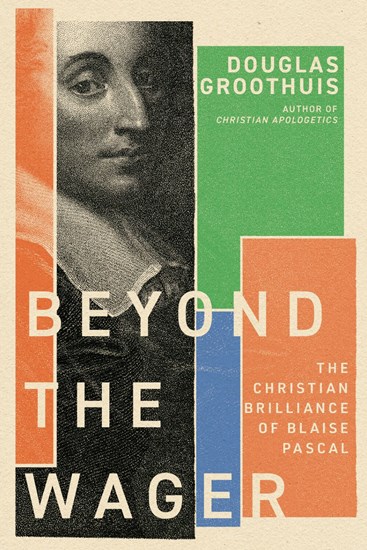
Beyond the Wager – The Christian Brilliance of Blaise Pascal by Douglas Groothuis (IVP Academic, 2024) is a fascinating look at the man who became famous for ‘Pascal’s Wager.’ Professor Groothuis ( Denver Seminary) revised and expanded a book he wrote about Pascal two decades ago. On Pascal was published in 2003.
The Book
Blaise Pascal is really famous for more than just his ‘Wager,’ as the author explains in great detail in his book. Pascal was born in France in 1623. Even though he lived a brief life (died 1662), he became world famous as a ‘scientist, inventor, philosopher, mystic, and theologian’ (Ch. 1, p 1).
Many know that the computer language “Pascal” is named after the man who invented the first calculator, but few know of his revolutionary philosophy of science, his other scientific achievements, his probing reflections on ethics, his apologetic for Christianity, or his piercing reflections on the enigmas of human nature. Ch. 1, p 1
Professor Groothuis wrote that “Pascal’s brilliance was a Christian brilliance.” I agree. I didn’t know about Pascal when I was an atheist, but came to deeply admire his brilliance after becoming a Christian. As Groothuis points out in his book, “Pascal’s most enduring work” is Pensées, which was published after Pascal’s death. Groothuis wrote that Pensées “is a collection of posthumously published fragments that Pascal had intended to become part of a book defending the Christian religion” (Ch. 1, p 2)
When Pascal laid out the strategy for this defense of Christianity, he did not dispense with reason as a tol for commending faith; he did not lay aside his prodigious intellectual skills by abandoning rational argumentation. Consider his program for his proposed apology.
“Order. Men despise religion. They hate it and are afraid it may be true. The cure for this is to show that religion is not contrary to reason, but worthy of reverence and respect. Next make it attractive, make good men wish it were true, and then show that it is. Worthy of reverence because it really understands human nature. Attractive because it promises true good.” (12/187)
Some of Pascal’s most memorable and oft-repeated sayings concern the strangeness and wonder of the human condition. But these were never offer as snippets of wisdom without purpose. They fit integrally into Pascal’s claim that Christianity is “worthy of reverence because it really understands human nature.” Pascal applied his considerable philosophical and rhetorical skills to that end, relying on the biblical account of human nature as his guide. Ch. 1, p 4
The Person of Jesus Christ
What someone believes about the Person of Jesus Christ answers many questions about the quality of their theology. I can say that with confidence because that’s according to the Lord’s apostles who spoke and wrote as inspired by the Holy Spirit. Here’s what Pascal thought about Jesus –
We know God only through Jesus Christ. Without this mediator all communication with God is broken off. Through Jesus we know God. Ch. 9, p 106
Here’s how Professor Groothuis viewed that statement –
BLAISE PASCAL TOOK JESUS CHRIST to be the fulcrum of existence. It is impossible to fathom Pascal’s worldview without noting and exploring his high Christology. For him, C hristy was not only the lynchpin of a philosophy of life; he was also the living center of redeemed existence, the Lord and Savior of the world, and the object of personal devotion, adoration, and service. Ch. 9, p 106
The Wager
So, what about the ‘wager’ – Pascal’s wager? Groothuis addresses that in detail toward the end of the book. I don’t want to give too much away, since I plan to recommend you read the book. However, here’s a little tease –
Having been presented with the options of God’s existence or nonexistence in a situation where reason cannot decide the case either way by proofs, Pascals’s interlocutor protests that no decision should be made. One should merely be agnostic and indifferent, which is the option of Pyrrhonoism.
Pascal responds that one must wager. Uncommitted agnosticism is not an option: “There is no choice, you are already committed. Which you choose then?” Ch. 12, p 167
I highly recommend Beyond The Wager to everyone interested in defending the Christian worldview – especially those of you who are involved in Christian Apologetics. Understanding how Blaise Pascal thought and what he said and wrote will be of great help to you as you consider sharing the Gospel with the world. I also recommend the book to agnostics who believe they don’t need to make a choice about God’s existence and the truth claims about Jesus Christ in the New Testament. I’ve been there, so I know that you are making a choice even though you think you aren’t. It’s vital that you make the right choice.
Contents
Preface
1. Blaise Pascal: Known and Unknown
2. A Short Life of Pascal
3. Scientist and Philosopher of Science
4. Theological Controversy
5. The Character and Plan of the Pensées
6. God: To Prove or Not to Prove
7. Skepticism and the Hidden God
8. Deposed Royalty
9. Jesus Christ: Miracles and Prophecy
10. The Excellence of Christ
11. Christianity, Mohammad, and the Jews
12. Wagering a Life on God
13. Pascal’s Critique of Culture and Politics
Conclusion: A Christian Genius for the Ages
Appendix: Descartes and Pascal Get into an Argument in Heaven
Bibliography
Name Index
Subject Index
Publisher’s Description
Blaise Pascal, the seventeenth-century French philosopher and scientist, is perhaps best known for his “wager,” an argument about the existence of God. But there was much more to Pascal and his brilliance.
In this accessible and well-documented study, philosopher Douglas Groothuis introduces readers to Pascal’s life as well as the breadth of his intellectual pursuits, including his contributions to mathematics, science, ethics, and theology. Groothuis overviews the key points of Pascal’s Pensées, which captures his thoughts about God, humanity, and Jesus Christ. Readers will also explore Pascal’s views on a range of topics, including culture, politics, Islam, and miracles.
Often quoted and often misunderstood, Pascal is a complex figure whose writings have charmed, puzzled, and inspired readers across the centuries. With guidance from a leading Christian thinker and longtime student of Pascal, Beyond the Wager takes you on a journey to discover the riches Pascal has to offer today.
Reviews
“I have been reading Blaise Pascal’s writings as well as other contemporary writers and apologists who have discussed Pascal and his ideas for at least three decades. Beyond the Wager: The Christian Brilliance of Blaise Pascal is one of the finest introductions to this amazing Christian thinker available. Douglas Groothuis’s fine book is both substantive and accessible—a must-read for all of us contemporary Pascalians.”
Kenneth Samples, senior scholar with Reasons to Believe
“This is a stunningly good and meticulously researched yet lively look at the work of the pioneering Christian thinker Blaise Pascal. Groothuis masterfully does for a new generation what needs to be done over and over, introducing this creative mind anew to show the importance of his tremendous insights for our time, and all times.”
Tom Morris, author of Philosophy for Dummies and Making Sense of It All
“Philosopher Douglas Groothuis has devoted decades to studying, teaching, and writing about Blaise Pascal, and it shows. Groothuis skillfully addresses Pascal’s fascinating life, scientific achievements, theological controversies, apologetic efforts, and more. His adept presentation of Pascal’s unique anthropological argument for Christianity is particularly superb. Beyond the Wager is an excellent resource for seasoned Pascal readers and those new to the compelling insights gleaned from the works of the French polymath.”
Robert Velarde, author of A Visual Defense: The Case For and Against Christianity
“A fine introduction to the breadth of Pascal’s apologetics, Douglas Groothuis’s Beyond the Wager is accessible without oversimplification and careful without pedantry. It includes intriguing discussions of little-known or overlooked arguments and ideas in Pascal’s thought, such as those concerning the status of messianic prophecies as evidence for the truth of Christianity and the rational appraisal of non-Christian religions.”
Michael Rota, professor of philosophy at the University of St. Thomas (Minnesota) and author of Taking Pascal’s Wager
“Blaise Pascal is a genius for the ages, though he’s often misunderstood and sometimes maligned. Douglas Groothuis’s treatment is admirable—one of the ablest philosophers of our day writing on one of the ablest of all time. No thoughtful defense of faith today can afford to avoid engagement with the brilliance and the passion of Pascal’s Pensées.”
Os Guinness, author of Fool’s Talk
About the Author
Douglas Groothuis (PhD, University of Oregon) is professor of philosophy at Denver Seminary. He is the author of numerous books, including Christian Apologetics, Fire in the Streets, Philosophy in Seven Sentences, Unmasking the New Age, Truth Decay, On Pascal, On Jesus, and Walking Through Twilight. He has written for scholarly journals such as Religious Studies, Sophia, Research in Philosophy and Technology, Journal of the Evangelical Theological Society, and Philosophia Christi, as well as for numerous popular magazines.
Beyond the Wager – The Christian Brilliance of Blaise Pascal by Douglas Groothuis (IVP Academic, 2024, 224 pages)
© Faith and Self Defense, 2024

 Faith & Self Defense