
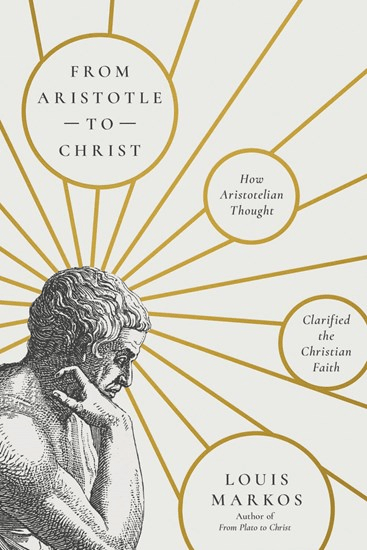
From Aristotle to Christ: How Aristotelian Thought Clarified the Christian Faith by Louis Markos (IVP Academic, 2025) is helpful in understanding how pagan philosophy impacted the thinking of many Christian leaders through the centuries.
Markos believes Christians should read the pagan classics. He is also the author of ‘From Achilles to Christ: Why Christians Should Read the Pagan Classics,’ and ‘From Plato to Christ: How Platonic Thought Shaped the Christian Faith.’
“In From Achilles to Christ, Louis Markos introduces readers to the great narratives of classical mythology from a Christian perspective. He dispels common notions about the dangers of reading classical literature and shows how hero stories are a foreshadowing of Christ.” (IVP, 2007)
“Christians throughout the history of the church and even today have inherited aspects of the ancient Greek philosophy of Plato. To help us understand the influence of Platonic thought on the Christian faith, Louis Markos offers careful readings of some of Plato’s best-known texts and then traces the ways that his work shaped some of Christianity’s most beloved theologians.” (IVP, 2021)
“When one studies the early church mothers and fathers, their debt to Plato is obvious. Unfortunately, few students and scholars continue reading into the high Middle Ages, where Aristotle’s thought becomes dominant, especially among the scholastic theologians, giving the impression that Plato’s influence is foremost in the history of Christian thought. Louis Markos shows how Aristotle’s influence is not just in scholasticism but all over the Christian tradition, reminding us that we owe a great debt to Aristotle too. This accessible book should be read by everyone interested in theology.” (IVP, 2025)
A Former Pagan’s Review
Before becoming an atheist I was involved in the practice of a variety of Eastern pagan philosophies (e.g. Hinduism, Taoism, Buddhism) because of my involvement in martial arts. I also read Western pagan philosophies from the Greek tradition (e.g. Plato, Aristotle) because of my interest in journalism, which eventually became my professional career.
While I found some helpful insights to living and thinking logically through my studies and practice, I didn’t find soul salvation until I investigated the truth claims about Jesus Christ in the Bible and discovered them to be true. That led me to a personal struggle about how to live my new life as a Christian having come from a background of pagan philosophies.
I’m not the only Christian to go through a similar struggle. Some early Christian leaders rejected pagan philosophies, while others accepted and even promoted them. Markos details that struggle in his book. Aristotle lived centuries before Jesus was born, which might cause some Christians to wonder what part the Greek philosopher could have possibly played in the life of the Church. Here’s how Markos ended his book:
“Though he lived and died long before Jesus taught his parables, Aristotle knew full well that choices have consequences and that the habits we cultivate determine the types of people we become and the kinds of societies in which we live. He understood the microcosm of human behavior as well as reason, logic, and virtue that bind them together. He still has much to teach us today: if only we will have ears to hear!” Conclusion, p 245
I’m not surprised that Markos would emphasize Aristotle’s emphasis on reason, logic, and virtue. That’s what I knew and appreciated about Aristotle before I became a Christian. That’s also what Markos emphasized in the first chapter of his book:
“Aristotle is the father of logic, not because he invented it out of whole cloth but because he recognized, clarified, and systematized the rules that govern the proper use of our rational faculties. There is an order without and an order within, and they reflect each other. How did Aristotle happen upon that dual order? By moving past mere thinking to engage in the metacognitive practice of thinking about thinking.” p 3
Markos details who and how Aristotle influenced Christian thinking and, as Markos put it, ‘clarified the Christian faith.’ Three of those Christian ‘thought’ leaders included Augustine, Thomas Aquinas, and Dante. Markos believes Aristotle’s influence was greater with Catholics than Protestants:
“I ask that you extend grace to the medieval and Renaissance Christians – Catholic and Protestant – who were willing to learn at the feet of Aristotle and to be guided in their thoughts and actions by his insights. Indeed, I think it best at the outset to warn my fellow evangelicals that Aristotle’s legacy has been greater among Catholics than Protestants. It was during the Catholic Middle Ages, after all, that Aristotle reigned supreme, exerting a strong influence on Thomas Aquinas and Dante and establishing philosophical methods that undergirded the work of the Scholastics (or Schoolmen). Sadly, it was precisely Aristotle’s connection to Aquinas and the Scholastics that earned him – unfairly – the scorn of both Martin Luther and John Calvin.” (Preface, x)
I have only scratched the surface of what you will learn from this book about Aristotle’s influence on Church beliefs and practices, so you will need to purchase the book to read the rest. While I do recommend that Christian apologists read ‘From Aristotle to Christ,’ I do have a caveat. I recommend you read it from the perspective of the dangers of human philosophy influencing Christian thought. No matter how brilliant a pagan philosopher may have been in their day, they were still pagans. People don’t become Christians and become like Christ by following the teachings of a pagan philosopher. That doesn’t mean a pagan philosopher can’t be right in some of their thinking, but their thinking will not lead a person to Eternal Life.
While I think Markos would agree with my last remark, based on what he wrote in his book, I still think it important that we remember the ‘Source’ of all true wisdom.
“Where is the wise? Where is the scribe? Where is the disputer of this age? Has not God made foolish the wisdom of this world? For since, in the wisdom of God, the world through wisdom did not know God, it pleased God through the foolishness of the message preached to save those who believe. For Jews request a sign, and Greeks seek after wisdom; but we preach Christ crucified, to the Jews a stumbling block and to the Greeks foolishness, but to those who are called, both Jews and Greeks, Christ the power of God and the wisdom of God. Because the foolishness of God is wiser than men, and the weakness of God is stronger than men.” 1 Corinthians 1:20-25
Publisher’s Description
[From the IVP Academic Website]
Discover how Aristotelian thought has shaped Christianity through history and remains relevant for Christians today
When Christians of any age, country, or denomination debate the nature of the good life, the soul, free will, or design, Aristotle lies behind their logic as well as their rhetoric. Although Aristotle did not have access to the Bible’s special revelation, he made full use of general revelation to arrive at deep truths about the nature of God, human identity, and the universe. In the Catholic Middle Ages the spiritual vision that undergirded Dante’s Divine Comedy was strongly indebted to Aristotle’s cosmology, and in the Protestant Reformation and Enlightenment the social vision of a well-run state was equally indebted to his political science.
In a follow up to his well-loved book From Plato to Christ, renowned scholar Louis Markos takes us on a vigorous and celebratory journey through the work of Plato’s greatest student, demonstrating Aristotle’s often unacknowledged influence on the Christian faith. In Markos’s hands, Aristotle is far from an irrelevant ancient philosopher but is instead an important conversation partner for some of history’s greatest Christian thinkers and a thoughtful guide to today’s most challenging questions.
With this book, you’ll:
- Consider the influence of Aristotle’s thought on the Christian faith,
- Carefully analyze several of Aristotle’s best-known texts,
- Trace Aristotle’s influence upon many key theologians in Christian history, and
- Understand Aristotle’s continuing importance for Christians today.
This book is a perfect addition to any classroom that seeks to understand how classical thought intersects with Christianity, both past and present. Grab your copy today and explore the relationship between Aristotelian philosophy and Christianity.
REVIEWS
“Louis Markos has done it again! If anything, this book is even more valuable than his earlier From Plato to Christ. Plato is generally easier to read, and so Aristotle is more in need of retrieval. Markos shows that, while there are places where Aristotle needs correction, his thought is immensely helpful for Christian reflection on God, human nature, virtue, friendship, politics, and rhetoric. May this book receive the wide audience it deserves, for the benefit of biblically grounded Christian faith and culture.”
Matthew Levering, James N. Jr. and Mary D. Perry Chair of Theology at Mundelein Seminary and author of Proofs of God
“When one studies the early church mothers and fathers, their debt to Plato is obvious. Unfortunately, few students and scholars continue reading into the high Middle Ages, where Aristotle’s thought becomes dominant, especially among the scholastic theologians, giving the impression that Plato’s influence is foremost in the history of Christian thought. Louis Markos shows how Aristotle’s influence is not just in scholasticism but all over the Christian tradition, reminding us that we owe a great debt to Aristotle too. This accessible book should be read by everyone interested in theology.”
Greg Peters, professor of Medieval and spiritual theology in the Torrey Honors College at Biola University
“I have been waiting a long time for a book like this one. We live in a difficult era, caught as we are between two extremes. On the one hand, radicals will tell us that if we listen to Aristotle, we will corrupt Christianity. On the other hand, modernism will tell us that we must dispense with Aristotle for the sake of revisioning classical Christianity. Against the radicals, we would do well to remember that our Protestant scholastic forefathers, many of whom were responsible for our Protestant confessions, critically appropriated Aristotle to further fortify the pillars of theology. Against modernism, Aristotle could not be more relevant, assisting us with the tools required to keep at bay everything from monism to materialism. The beauty of Louis Markos’s book is the way he introduces the novice to the wisdom of Aristotle to better equip Christianity with a defense of its foundational commitments. In a secular age prone to skepticism, what student can afford not to read Markos and consider the myriad ways Aristotle can clarify what we believe and why?”
Matthew Barrett, Research Professor of Theology at Trinity Anglican Seminary and author of The Reformation as Renewal
CONTENTS
Preface: A Platonist Learns to Love Aristotle
A Note on Translation
Part 1: How to Think Logically
1. Why It’s Impossible to Believe Six Impossible Things Before Breakfast
2. Playing Around in Aristotle’s Toolbox
3. Making Arguments That Make Sense
4. Why Things Move and Change
5. Body and Soul in Dialogue
Part 2: How to Read the Heavens and the Earth
6. Why, Why, Why
7. Where Do I Begin?
8. Wrestling with the Static God of Deism
9. Living in an Ordered Universe
10. Joining the Cosmic Dance of
Part 3: How To Behave
11. Studying the Psyche
12. Virtue as Habit
13. Finding the Golden Mean
14. How to Win Friends and Influence People
15. The Good Life
Part 4: How to Get Along with Our Neighbors
16. The Political Animal
17. A Critic and a Defender of Aristotle
18. The Blessings and Dangers of Private Property
19. The Rule of Law
Part V: How to Make Beautiful Things
20. Defending the Art of Rhetoric
21. Redeeming the Art of Imitation
22. Purging and Purifying the Emotions
Conclusion: Aristotle the Prophet
Glossary
Bibliographical Essay
Scripture Index
ABOUT Louis Markos

Louis Markos (PhD, University of Michigan) is professor of English and scholar in residence at Houston Christian University, where he holds the Robert H. Ray Chair in Humanities. His many books include From Achilles to Christ: Why Christians Should Read the Pagan Classics, From Plato to Christ: How Platonic Thought Shaped the Christian Faith, The Myth Made Fact: Reading Greek and Roman Mythology through Christian Eyes, Apologetics for the 21st Century, Atheism on Trial, From Aristotle to Christ, and On the Shoulders of Hobbits: The Road to Virtue with Tolkien and Lewis.
From Aristotle to Christ: How Aristotelian Thought Clarified the Christian Faith (IVP Academic, 2025, 288 pages)
Faith and Self Defense © 2025
 Faith & Self Defense