
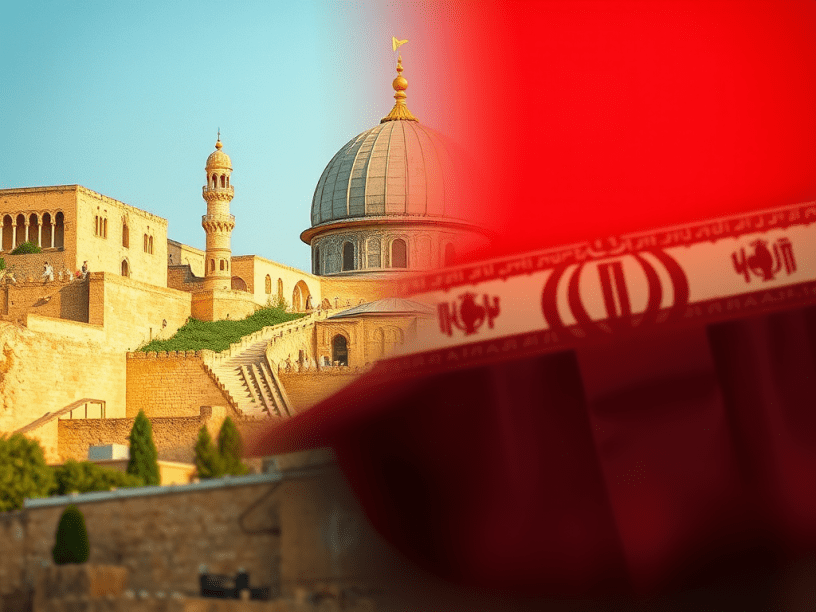
Why do Christians seem so divided about the war between Iran and Israel and America’s involvement in it? Could theological differences be one reason?
I addressed various views on ‘Millennialism’ in the last part of our series. One of the things I’ve learned through years of Bible study is that an error in one area of theology often leads to errors in other areas of theology. One example is the error of ‘Amillennialism.’
Keep in mind that I approach Bible study from the aspect of ‘rightly dividing the word of truth’ (2 Timothy 2:15). I don’t approach Bible study from any particular denominational perspective. The very use of the word ‘denominational’ tells us that there are ‘divisions’ within Christianity. If a student of the Bible focuses on ‘rightly dividing’ the Word of Truth, they will ‘make a straight cut, dissect correctly, handle correctly’ God’s Word. The Greek word is ὀρθοτομέω (orthotomeó).
Also, just a quick reminder about my rules for Bible study before we begin this part of the series:
- See everything
- Ask everything
- Answer everything
- Interpret everything
- Text
- Within Context
- From the Original Language
- To the Original Reader
With those introductions out of the way, let’s jump into the deep end of theology.
The ‘Church’ as Spiritual Israel
Amillennialists believe that the ‘Church’ is ‘Spiritual Israel.’ What does that mean?
First, the term ‘Spiritual Israel’ is not used anywhere in the Bible. That means it’s not connected to the Church in Scripture. So, who started using the words? We’ll have to go back more almost 1,900 years to a man named Justin Martyr. Here’s what he wrote in approximately 155 AD in a writing known as ‘Dialogue with Trypho:’
CHAPTER CXXXV — CHRIST IS KING OF ISRAEL, AND CHRISTIANS ARE THE ISRAELITIC RACE.
“And when Scripture says, ‘I am the Lord God, the Holy One of Israel, who have made known Israel your King,’ will you not understand that truly Christ is the everlasting King? For you are aware that Jacob the son of Isaac was never a king. And therefore Scripture again, explaining to us, says what king is meant by Jacob and Israel: ‘Jacob is my Servant, I will uphold Him; and Israel is mine Elect, my soul shall receive Him. I have given Him my Spirit; and He shall bring forth judgment to the Gentiles. He shall not cry, and His voice shall not be heard without. The bruised reed He shall not break, and the smoking flax He shall not quench, until He shall bring forth judgment to victory. He shall shine, and shall not be broken, until He set judgment on the earth. And in His name shall the Gentiles trust.’ Then is it Jacob the patriarch in whom the Gentiles and yourselves shall trust? or is it not Christ? As, therefore, Christ is the Israel and the Jacob, even so we, who have been quarried out from the bowels of Christ, are the true Israelitic race. But let us attend rather to the very word: ‘And I will bring forth,’ He says, ‘the seed out of Jacob, and out of Judah: and it shall inherit My holy mountain; and Mine Elect and My servants shall possess the inheritance, and shall dwell there; and there shall be folds of flocks in the thicket, and the valley of Achor shall be a resting-place of cattle for the people who have sought Me. But as for you, who forsake Me, and forget My holy mountain, and prepare a table for demons, and fill out drink for the demon, I shall give you to the sword. You shall all fall with a slaughter; for I called you, and you hearkened not, and did evil before me, and did choose that wherein I delighted not.’ Such are the words of Scripture; understand, therefore, that the seed of Jacob now referred to is something else, and not, as may be supposed, spoken of your people. For it is not possible for the seed of Jacob to leave an entrance for the descendants of Jacob, or for [God] to have accepted the very same persons whom He had reproached with unfitness for the inheritance, and promise it to them again; but as there the prophet says, ‘And now, O house of Jacob, come and let us walk in the light of the Lord; for He has sent away His people, the house of Jacob, because their land was full, as at the first, of soothsayers and divinations;’ even so it is necessary for us here to observe that there are two seeds of Judah, and two races, as there are two houses of Jacob: the one begotten by blood and flesh, the other by faith and the Spirit.” Roberts-Donaldson English Translation: Dialogue with Trypho
We might ask why a second century Christian philosopher and apologist would say something like that since it’s not in Scripture and couldn’t have come from the apostles – especially Paul who had received the ‘mystery’ of the Church as the Body of Christ from the Holy Spirit. Justin reportedly grew up as a pagan and studied under many pagan philosophers. He didn’t study with any of the Apostolic Fathers as far as we know. If that’s true, he wouldn’t have gotten the idea from them. Some theologians believe that was Justin’s way of addressing issues about Judaism and Christianity following Rome’s destruction of the Temple in 70 AD and the Jewish revolt against Rome known as the Bar Kokhba revolt in 135 AD. The Roman Army crushed the Jews and brought the revolt to an end.
That brought Israel’s hopes for a Messianic intervention to an end (many Jews believed Bar Kokhba might be the Messiah). That led some Christians to believe God was done with Israel and the Church would ‘replace’ Israel in God’s plans for the future. They began to look at promises to Israel in Scripture as being transferred to the Church. Ethnic Israel became obsolete. The Church was, in many Christian’s opinion, ‘Spiritual Israel.’
Replacement Theology
Justin Martyr’s views about ‘Spiritual Israel’ introduced the idea of ‘supersessionism’ (from the Latin supersedere, ‘to take the place of, to sit above’). ‘Supersessionism’ became the primary interpretation of Roman Catholic, Eastern Orthodox, and Protestant churches for centuries. However, views changed a little after the Holocaust during World War II, and the establishment of the State of Israel also after World War II. I say ‘changed a little’ because Replacement Theology and Spiritual Israel remain the primary views of many Christian denominations to this day.
You may find this article interesting from one of the largest ‘Christian’ groups in the world:
“Supersessionism is the view that Christianity has “superseded,” or “replaced,” Judaism as the (single) path to salvation.
In 2015 the Vatican said:
Supersessionism steadily gained favour until in the Middle Ages it represented the standard theological foundation of the relationship with Judaism. (“The Gift and Calling of God are Irrevocable,” 17)
Supersessionism (also called “Substitution Theory” or “Replacement Theory”) is the view that Judaism has been replaced by Christianity. Abrogationist Supersessionism views Judaism as completely ended. Thus, Christianity is an entirely new faith, with no continuity between the two.
Fulfillment Supersessionism views Christianity as supplementing Judaism. It has replaced some aspects of Mosaic Judaism, such as animal sacrifice. But there is nevertheless a valued continuity between the faiths, such as the shared Revelation of the Old Testament.
St. Thomas Aquinas (1225–74) provided the classic medieval summary of the relationship between Judaism and Christianity. He stated:
The… redemption of the human race was fulfilled in Christ’s passion… Consequently the prescriptions of the (Jewish) Law must have ceased, as their reality was fulfilled… Before Christ’s passion… the law and the gospel were concurrent, as the mystery of Christ had begun, but was not yet consummated (on the cross). (Summa Theologiae, 1-2, Q.103, a.3 ad.2)
Pope John Paul II seems to have interpreted Vatican II as not rejecting Supersessionism.
He spoke warmly of Judaism and he was praised by the Jewish Anti-Defamation League for his work in combatting Antisemitism. He said to a Jewish audience:
You are our dearly beloved brothers, and in a certain way, it could be said that you are our elder brothers. (Address, 1986)
Israel – Blindness in Part
I find it unfortunate that a majority of Christians for the last many centuries have bought into the idea of ‘Spiritual Israel’ and ‘Replacement Theology’ even though it’s not stated as such in the Bible. Christians are influenced heavily by their pastors and denominational leaders, so I hope some of them are reading this series and thinking about how they ‘rightly divide’ God’s Word.
Paul addressed the ‘Israel/Church’ issue almost two thousand years ago in his letter to the Romans. The church in Rome included converted Jews and Gentiles, so Paul addressed them all throughout the lengthy epistle. He wrote it during his third missionary journey in approximately 56 or 57 AD, probably while he was in Corinth.
Paul wrote that Israel had rejected Christ and needed to hear and accept the Gospel of the Grace of God that he preached. However, Israel had rejected the Gospel as well. Did that mean God had ‘cast away’ His people? Paul’s answer was emphatic:
“I say then, has God cast away His people? Certainly not!” Romans 11:1
Why then had this happened to Israel?
“I say then, have they stumbled that they should fall? Certainly not! But through their fall, to provoke them to jealousy, salvation has come to the Gentiles. Now if their fall is riches for the world, and their failure riches for the Gentiles, how much more their fullness! For I speak to you Gentiles; inasmuch as I am an apostle to the Gentiles, I magnify my ministry, if by any means I may provoke to jealousy those who are my flesh and save some of them. For if their being cast away is the reconciling of the world, what will their acceptance be but life from the dead?” Romans 11:11-15
Remember that God revealed ‘mysteries’ (secrets) to Paul (e.g. 2 Corinthians 12; Ephesians 3). Here’s one from the context of what God will do with Israel:
“For I do not desire, brethren, that you should be ignorant of this mystery, lest you should be wise in your own opinion, that blindness in part has happened to Israel until the fullness of the Gentiles has come in. And so all Israel will be saved, as it is written: “The Deliverer will come out of Zion, And He will turn away ungodliness from Jacob; For this is My covenant with them, When I take away their sins.” Romans 11:25-27
Paul did not want Christians do be ‘ignorant of this mystery.’ What was the mystery? ‘… that blindness in part has happened to Israel until the fullness of the Gentiles has come in.’ The Greek word for ‘blindness’ is πώρωσις (pórósis). It means ‘hardening, callousness, stupidity, blindness.’ That’ what happened to Israel, but there’s a caveat – ‘until the fullness of the Gentiles has come in.’ What does that mean?
The Greek word translated ‘fullness’ is πλήρωμα (pléróma) and means ‘fulfillment, completion, what is full.’ Notice that Paul referenced the ‘completion’ or ‘fulness’ of the ‘Gentiles.’ Who did he mean in the context of his letter to the church in Rome? Those Gentiles who were ‘saved by grace through faith’ in Jesus Christ (Ephesians 2:8-9). He knew there was coming a time when the last Gentile would be saved and that God would then do this:
“And so all Israel will be saved, as it is written: “The Deliverer will come out of Zion, And He will turn away ungodliness from Jacob; For this is My covenant with them, When I take away their sins.” Romans 11:26-27
Israel has been ‘blinded’ for centuries, but the time is coming when God will ‘turn away ungodliness from Jacob.’ That’s a future event. I love how Paul ended this section (chapters 9 – 11):
“Oh, the depth of the riches both of the wisdom and knowledge of God! How unsearchable are His judgments and His ways past finding out! “For who has known the mind of the Lord? Or who has become His counselor?” “Or who has first given to Him And it shall be repaid to him?” For of Him and through Him and to Him are all things, to whom be glory forever. Amen.” Romans 11:33-36
God is going to do what He promised Israel He was going to do. They rejected Him so many times during their history as a nation, but He continued to work with them as a nation. However, when they rejected Jesus and the message of His disciples, the Lord raised up Saul of Tarsus to take the Gospel of God’s Grace to the Gentiles. When that part of God’s plan is complete, He will finish the work He started centuries earlier with Israel.
I look forward to that day when ‘the fullness of the Gentiles’ will have come in. The Lord will take us home ‘in the twinkling of an eye,’ and bring about the ‘last things’ He promised His Jewish disciples two thousand years ago.
Next Time
Before I bring this series to an end I’d like to address one more issue that you may find helpful in your study about Iran and Israel at War.
Scripture taken from the New King James Version®. Copyright © 1982 by Thomas Nelson. Used by permission. All rights reserved.
Faith and Self Defense © 2026



Thanks so much for your deep insight into this ongoing war. Your perspective gave me a lot of food for thought. Keep writing, keep enlightening.