
My belief as an atheist was that God did not exist, the Bible was not a credible compilation of writings, and that Jesus of Nazareth never existed. However, a guest on my radio talk show in 1971 challenged my thinking about that. He was a Christian and a well-known scientist. His challenge got me started in the area of science.
I’ve already detailed my investigation in a lengthy series of articles that ran for more than a decade (2012-2026). This is how I ended the series in January 2026:
As I investigated the truth claims of theism and Christianity, I thought back to the conversations I had had with atheist leaders on my radio talk show (e.g. Madalyn Murray O’Hair, Freethinkers) and the many atheist writers I had read (e.g. Bertrand Russell, Friedrich Nietzsche, David Hume). I considered the evidence for atheism they had given me along with the new evidence I was learning about from Christian apologists. The evidence for theism and Christianity was stronger.
It came down to which worldview had the better evidence. Once I became a follower of Jesus Christ many other things came into view that have changed me as a person. I found purpose and reason for life because I became connected to Life Himself.
Jesus said to him, ‘I am the way, the truth, and the life. No one comes to the Father except through Me.’ John 14:6
That is a profound truth claim. Either it is true or it is not. I believe it is true. I believe that Jesus of Nazareth, the Christ, is the Son of God. I believe that He is the way, the truth, and the life. I believe that no one comes to God the Father except through Jesus.
More About Science
Dr. Henry Morris and I discussed the following ‘sciences’ during a two-hour interview:
- The Cosmological Argument
- The Teleological Argument
- The Law of Causality
- The Laws of Thermodynamics
- Geology
- Flood Hydrology
- Archaeology
- Among Many Others
What has happened in the last 55 years since I became a Christian theist is that ‘science’ has strengthened the argument for the existence of God. I addressed some of the findings concerning the ‘Cosmological Argument’ in the last part of this series. It’s simply a matter of reading all sides of scientific ‘positions’ or ‘arguments.’ You will probably find that one position presents better evidence than another position if you spend enough time searching various studies.
Two of the primary positions that I researched before and since becoming a Christian are ‘evolution’ and ‘creation.’ Scientists from both perspectives seem to agree that something (or someone) started the Universe in which we live. Some believe that what we see and experience in the world and universe today came about through a lengthy ‘process by which new species or populations of living things develop from preexisting forms through successive generations’ (Merriam-Webster). The ‘standard age’ of the Universe according to many evolutionary scientists is about 13.8 billion years. Some Christians who believe in theistic evolution would agree, though they think God intervened from time to time in the evolutionary process to accomplish His objectives. Many other Christians take the biblical account literally and view the ‘heavens and the earth’ as being thousands of years old rather than billions. Who is right?
That has been a question I’ve researched during the last 55 years since converting from atheist to theist. I’ve read hundreds of books, articles, papers, etc., from all sides and have witnessed the scientific struggle to ‘prove’ any theory about the ‘origin’ of the universe. The best we can do is look for evidence that leads us to the ‘best explanation.’
The Teleological Argument

AI Generated
This is where telescopes and microscopes and other advanced technology help us find that ‘best explanation.’ While creationists had long believed in a universe and earth much younger than evolutionists, the 1980s became what many saw as a pivotal decade for the modern theory of ‘intelligent design’ (ID). Many scientists began re-evaluating information about the origin and age of the universe and life itself.
One of the scientific arguments Dr. Morris presented that caught my interest was the ‘Teleological’ argument. The name comes from the Greek word τέλος and means ‘an ultimate end.’ The idea is that there is an ‘end, goal, purpose’ for something. The Teleological Argument is an ‘argument from design.’ That opposes the theory of evolution which posits a lack of purpose.
“Natural selection is the simple result of variation, differential reproduction, and heredity — it is mindless and mechanistic. It has no goals; it’s not striving to produce “progress” or a balanced ecosystem.” Understanding Evolution, Berkley University
Three aspects of the Teleological Argument include:
- Fine Tuning
- Irreducible Comlexity
- Regularity
Here are some scientific findings since my investigation as an atheist in 1971 that you might find interesting. Just a reminder that I’ve read scientific articles and books from atheist, agnostics, Christians, and others, so this is not specifically a view from ‘Christian’ scientists alone. I want to know the truth, which means spending time looking at important scientific positions from a variety of views.
Let’s begin with the idea of the ‘fine-tuning’ of the universe.
Fine Tuning
Paul Davies is not a Christian, theist, or deist. He is an internationally known physicist who wrote some books I found quite interesting about this subject. He is Regent Professor in the Department of Physics at Arizona State University. Here’s how he describes his scientific work –
“By profession, I am a theoretical physicist who has worked for much of my career in astrophysics and cosmology, with emphasis on the origin and very early stages of the universe, the quantum properties of black holes and the nature of time … My main approach to research is to explore the proverbial ‘big questions’ of existence, from what happened before the big bang, to whether or not we are alone in the universe. These are questions of interest to philosophers and even theologians too.” Arizona State University
His areas of expertise include astrophysics, cosmology (including dark matter and dark energy), and theoretical elementary particle physics. Davies has written many books and scores of scientific papers on these and other topics. Some of the books he wrote after I became a Christian were:
- Other Worlds (1980)
- The Edge of Infinity (1981)
- God and the New Physics (1983)
- The Mind of God: The Scientific Basis for a Rational World (1993)
- About Time: Einstein’s Unfinished Revolution (1996)
- Other Worlds: Space, Superspace, and the Quantum Universe (1997)
This is what Davies’ publisher wrote about him:
“Paul Davies explains the significance of the amazing quantum universe, where fact is stranger than any science fiction. He takes us into a world where commonsense notions of space, time, and causality must be left behind as the realm of solid matter dissolves into vibrating patterns of ghostly energy, and where mind and matter are interwoven in a subtle and holistic manner. An Australian physicist and author of GOD AND THE NEW PHYSICS, Davies writes for the lay reader in simple language … The most profound and age-old questions of existence — for centuries the focus of religion and philosophy — may soon be answered through the extraordinary advances of a field of science known as the new physics. In this illuminating work, Paul Davies, author of the acclaimed Other Worlds and The Edge of Infinity, writes that the discoveries of 20th-century physics — relativity and the quantum theory — are now pointing the way to a new appreciation of man and his place in the universe. They could, in fact, bring within our grasp a unified description of all creation. Demanding a radical reformulation of the most fundamental aspects of reality and a way of thinking that is in closer accord with mysticism than materialism, the new physics, says Davies, offers a surer path to God than religion.”
Davies takes a different perspective on the topic of the existence of God than many Christians do, but he has written that the fine-tuning of the universe represented – ‘the most compelling evidence for an element of cosmic design.’ As I’ve read the writings of non-Christian scientists during the last 50+ years, it’s become clear to me that positions have and are changing toward the idea of the universe and our earth being ‘fine tuned.’ Many Christians have quoted from these scientists through the years because of what they believe about observations that even slight changes in fundamental constants would make life impossible.
“At the moment the Big Bang began, everything that exists—matter, energy, the three dimensions of space, and the fourth dimension of time—emerged from a single geometric point, expanding at the speed of light. Scientists are amazed that the explosive violence of the creation event was as perfectly, delicately balanced as it was. Cosmologist Paul Davies wrote:
Had the Big Bang been weaker, the cosmos would have soon fallen back on itself in a big crunch. On the other hand, had it been stronger, the cosmic material would have dispersed so rapidly that galaxies would not have formed. . . . Had the explosion differed in strength at the outset by only one part in 1060, the universe we now perceive would not exist. To give some meaning to these numbers, suppose you wanted to fire a bullet at a one-inch target on the other side of the observable universe, twenty billion light-years away. Your aim would have to be accurate to that same part in 1060. . . . Channeling the explosive violence into such a regular and organized pattern of motion seems like a miracle.
If the explosive force of the Big Bang not been perfectly balanced and incredibly fine-tuned, life would be impossible—and you and I could not exist.” Jim Denney, Cosmic Coincidence—or Calculated Design?, 2019
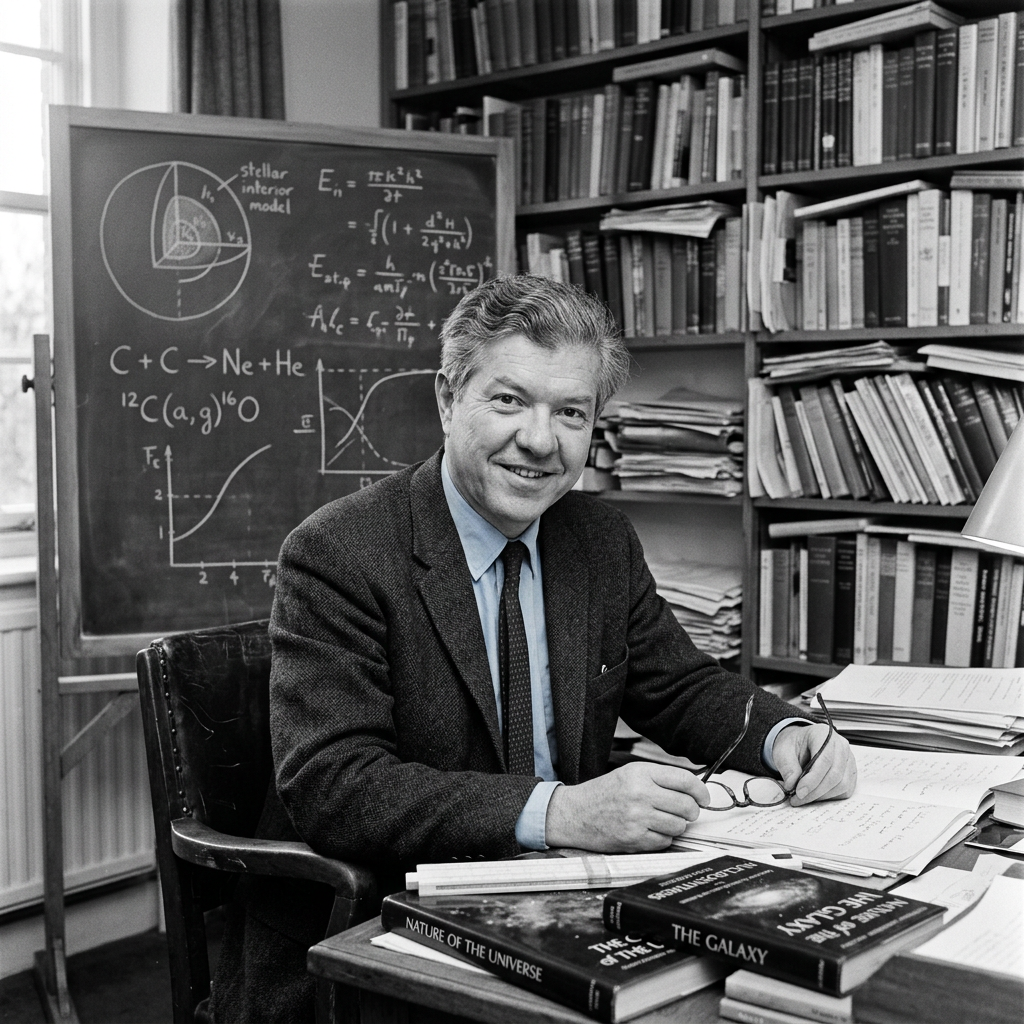
One of the astrophysicists I researched in 1971 was Sir Fred Hoyle. He coined the term ‘Big Bang’ for cosmology even though he didn’t believe in it. He gave talks on the BBC after World War II about his preferred cosmology known as the ‘Steady State’ hypothesis. Here’s more about what he believed when I first read about him:
“Because the Big Bang hypothesis was proposed by George Gamow and colleagues in 1948 to account for the origin and relative abundance of the chemical elements, and because Hoyle rejected the Big Bang, he needed an alternative way of explaining where lithium and iron and such elements came from, and he found his crucible in the cores of giant stars. He and three colleagues – Margaret and Geoffrey Burbridge, and Willy Fowler – published a very famous paper in 1957 called “The synthesis of the elements in stars”, in which they showed how the conditions in stellar interiors would be conducive to cooking up hydrogen and helium into carbon and oxygen and all the rest of the heavy elements. The paper is so well-known, and so often cited, that it has a short-hand designation, B2FH, wrought from the author’s last names, and pronounced “B-squared-F-H”, where Hoyle is the “H”. It is interesting that Gamow turned out to be right about the Big Bang and wrong about the origin of the elements, while Hoyle also batted .500, since he was wrong about the Steady State hypothesis but ever so right about elements forming in stars. The eccentric Hoyle emerged later. He rejected the idea that life emerged on earth from organic molecules and preferred to advocate “panspermia,” the notion that life came to earth from space. He spent some years debunking Archaeopteryx, the famous fossil “first bird,” which Hoyle claimed was a fake, in spite of overwhelming evidence in favor of its authenticity. He proposed that flu epidemics were related to sunspot cycles, because when solar activity was at a minimum, the flu virus could then make its way to earth from outer space. When Antony Hewish received the Nobel Prize in 1974 for the discovery of pulsars, Hoyle publicly ripped the Nobel Committee for giving Hewish the award and not including his graduate student, Jocelyn Bell, who had actually made the discovery (here Hoyle was being not so much eccentric as undiplomatic, since he was absolutely right to be critical of the omission of Bell). Hoyle’s war with the scientific establishment may explain another odd Nobel Prize, awarded to Willy Fowler in 1983, in part for the discovery of stellar nucleosynthesis, as presented in B2FH. Hoyle was not included in the award, although he was the lead author. Perhaps the Nobel committee was flexing its muscles and demonstrating who calls the shots, and who doesn’t, in determining Nobel prizes. Or who knows, perhaps someone on the committee had read Hoyle’s science fiction novel, The Black Cloud (1957), in which scientists save the earth from an extra-terrestrial super-organism, while administrators and government men run around like babbling idiots.” Scientist of the Day – Fred Hoyle
Hoyle was an atheist at the time, but some people believe he may have become agnostic before his death in 2001. He wrote this in 1982:
“A commonsense interpretation of the facts suggests that a super intellect has monkeyed with physics, as well as chemistry and biology, and that there are no blind forces worth speaking about in nature. The numbers one calculates from the facts seem to me so overwhelming as to put this conclusion almost beyond question.” The Universe: Past and Present Reflections. Annual Review of Astronomy and Astrophysics
You may find this article interesting to read concerning Sir Hoyle’s theories – Has a Superintellect Monkeyed With Our Universe’s Physics?
One of the arguments I’ve heard from evolutionists through the years is the possibility of a ‘multiverse.’ What is that? Here’s an interesting article from Paul M. Sutter who is a cosmologist at Johns Hopkins University:
“It appears that we live on the knife-edge, where only the narrowest combination of values for the fundamental constants allow life, and especially conscious life, to arise.
This is the heart of the fine-tuning argument: that the universe appears to favor the existence of life. So why are we here?
One answer is to simply end the line of thinking right there. The constants are the way they are because if they were different, we wouldn’t be here to observe it. This is called the anthropic argument: Life exists because otherwise, it would be impossible for life to exist.
Many physicists and philosophers consider this argument a little less than satisfying. While it does answer the question, we seem to have this nagging feeling that there’s more to the story.
Another possibility is that there’s more than one universe — that we live in a multiverse, with each different universe “sampling” different values of the constants. There are a few extremely hypothetical ideas in physics that can lead to the multiverse. One is through the concept of eternal inflation, where the very early universe never ended its period of rapid expansion and different portions of the overall multiverse “pinched off” to create their own bubble universes.
Another path to the multiverse comes from string theory, where extra spatial dimensions can twist up on themselves in a dizzying number of ways. Each possible arrangement would lead to new values of the physical constants, and even entirely new laws of physics. The range of possible combinations is known as the landscape, with our universe consisting of one point in that landscape.
In these multiverse-inspired ideas, there are a multitude of universes “out there” that don’t support life — but this one does, so here we are. At the end of the day, it’s still the anthropic argument, but at least it’s one that explains how different values of the constants can be realized.” The physics of the universe appear to be fine-tuned for life. Why?
I thought the way Sutter ended the article was telling: “So no matter what, we can’t yet escape some form of fundamental constant, or some form of knowledge about the universe that we can’t explain from our theories themselves. I suppose we’ll just have to keep digging.” He wrote his article in May of 2025, so it demonstrates that the scientific community is still searching for answers to questions many Christians view as quite simple: “In the beginning God created the heavens and the earth.”
I could share hundreds of scientific articles from the last 55 years about research into the ‘fine-tuning’ of the universe. It’s been interesting to see so many non-Christians in the scientific community coming over to the idea of a universe that was ‘fine-tuned’ for life.
I’ll leave you with one more article that was published online by Cambridge University Press in 2025. Here’s the abstract:
“In recent decades, it has become clear that if our universe had been born with slightly different physics, e.g. if the masses of fundamental particles were altered by a tiny fraction, it would be sterile and uninhabitable. We explore the current state of the evidence for this cosmological fine-tuning. We then explore three possible explanations of fine-tuning: traditional theism, the multiverse hypothesis, and a pantheistic God of limited power.” Cosmological fine-tuning: the view from 2025
Some of the highlights of the article include:
- Part I: The fine-tuning of the universe for life (Geraint F. Lewis and Luke A. Barnes)
- Cosmological fine-tuning: the evidence
- The cosmological constant
- The Higgs vacuum expectation value
- The masses of the up quark, down quark, and electron
- The force coupling constants
- Scalar fluctuation amplitude
- Part II: Explaining fine-tuning – three perspectives
- Geraint F. Lewis: Cosmological fine-tuning from a scientific perspective
- Luke A. Barnes: Cosmological fine-tuning from a theistic perspective
- Philip Goff: Cosmological fine-tuning from a limited pantheistic perspective
Next Time
I’ll look at arguments for and against Irreducible Complexity as my series continues, Still Convinced After All These Years.
Scripture taken from the New King James Version®. Copyright © 1982 by Thomas Nelson. Used by permission. All rights reserved.
Faith and Self Defense © 2026


